


 346-200-6097
Separating Forensic Reality from TV Fiction
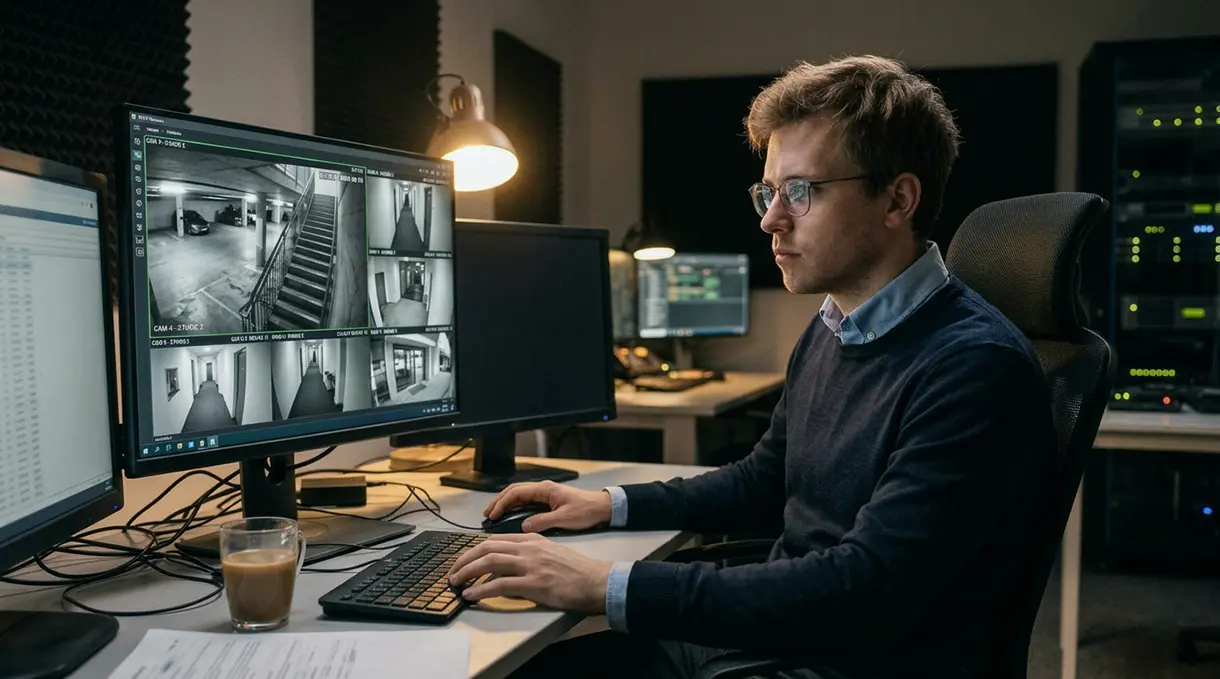
You've seen it on television a hundred times. A detective squints at a grainy surveillance monitor and says, "Can you enhance that?" The technician taps a few keys, and suddenly a blurry blob becomes a crystal-clear face. The suspect is identified. Case closed.
If only it worked that way in real life.
As forensic video analysts, we hear this request constantly from attorneys, investigators, and business owners. The "CSI effect" has created an expectation that digital magic can recover details that were never actually captured. The truth is more complicated, and understanding it can mean the difference between evidence that holds up in court and evidence that gets thrown out.
This guide explains what video forensics actually is, what enhancement can and cannot do, and how to handle video evidence properly from the moment you receive it.
What is video forensics?
Video forensics is the scientific analysis of video evidence. It goes far beyond simply watching footage. At its core, the discipline rests on three pillars: authentication, clarification, and interpretation.
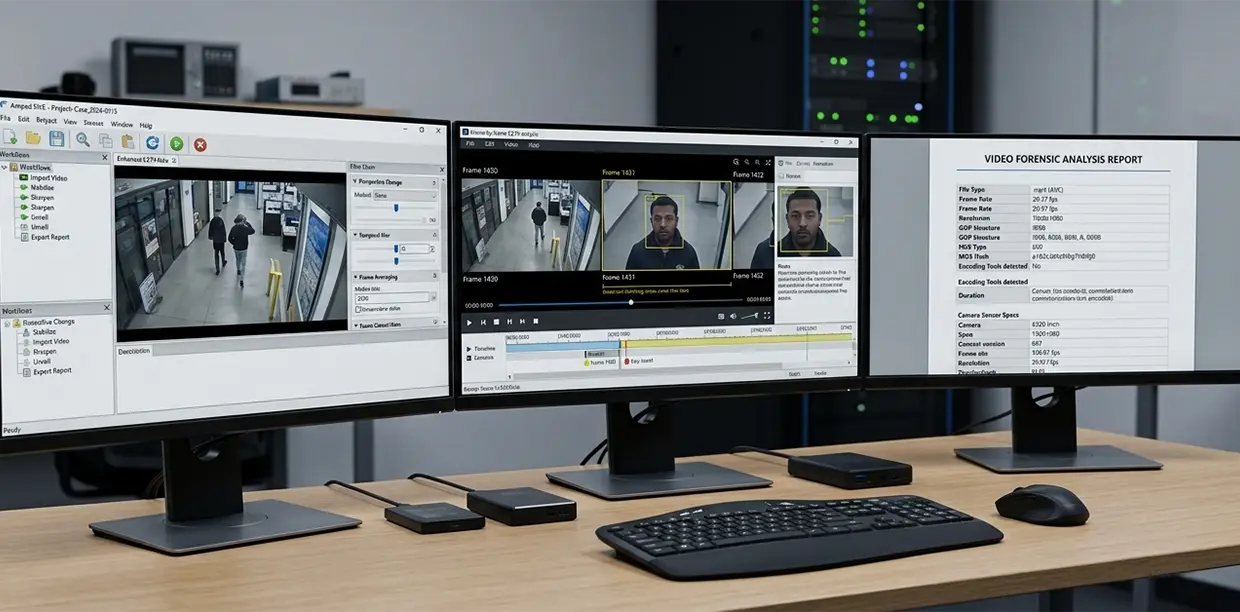
Authentication verifies that the video is consistent with that of a genuine video file and has not been tampered with. This involves examining metadata, looking for signs of editing, and confirming the chain of custody.
Clarification improves the visibility of details that are present but difficult to see. This is what most people mean when they ask about "enhancement."
Interpretation puts the video in context. What exactly is happening? When did it occur? What do the visible details actually tell us about the event?
The chain of custody matters enormously in video forensics. Every handoff, every transfer, every copy creates potential questions about authenticity or, even worse, can alter the data depending upon how it was transferred. The original file recorded by the camera system is the gold standard. Exports, compressed copies, and especially screenshots degrade quality and introduce questions about what might have been lost or altered.
Metadata and encoding considerations also play a crucial role. Video files contain technical information about how they were created: timestamps, camera settings, compression formats. Understanding this data requires specialized knowledge and tools.
Standards bodies like the Scientific Working Group on Digital Evidence (SWGDE) and the National Institute of Standards and Technology (NIST) establish guidelines that ensure forensic analysis meets scientific standards for legal admissibility.
What "enhancement" actually means
Let's be clear about what enhancement actually does. It improves the visibility of data that already exists in the video file. It does not create new information.
Enhancement is NOT:
- Adding pixels that were never captured
- Guessing what details might have looked like
- Using AI to hallucinate missing information
- Magically reconstructing faces from blurry blobs
Real enhancement techniques include:
- Brightness and contrast adjustment to reveal details hidden in shadows or glare
- Noise reduction to remove visual static that obscures important features
- Stabilization to reduce camera shake and make movement clearer
- Frame averaging to combine multiple frames and reduce random noise
- Temporal filtering to analyze changes across multiple frames
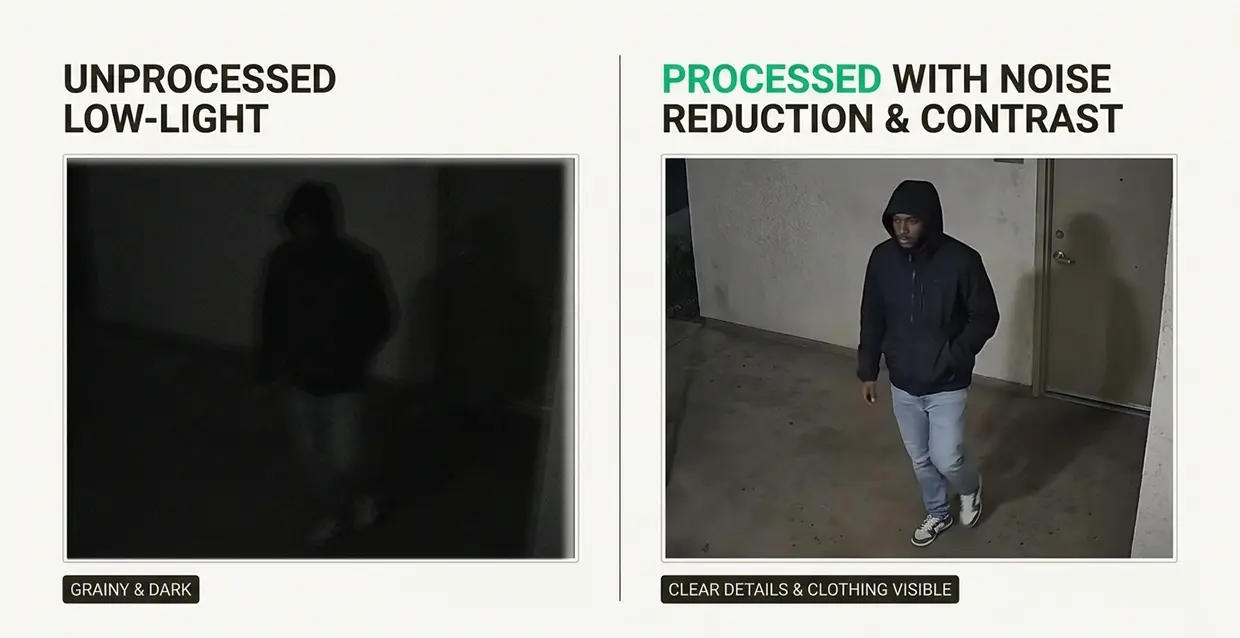
The principle is simple: garbage in, garbage out. If the camera never captured the detail, no amount of processing can recover it. Enhancement can only make visible what is already there, buried under noise, poor lighting, or compression artifacts.
As the team at Amped Software, creators of the industry-standard Amped FIVE forensic video software, explains: if the information is present in the image but not visible because of some defect, proper scientific procedures can recover it. If the information is not there in the original footage, we cannot (and must not) add it or recreate it.
The biggest misconception: "Zoom and enhance"
The most persistent myth in video forensics is the idea that we can "zoom and enhance" blurry footage to reveal crystal-clear details. This is physically impossible.
Pixels cannot be created from nothing. A digital image is made up of a fixed grid of pixels, each containing specific color and brightness information. When you zoom in beyond the native resolution, you are simply making each pixel larger. The software may use interpolation to smooth the appearance, but it cannot invent detail that was never captured.
Resolution limits are real and unforgiving. A 640x480 surveillance camera captures 307,200 pixels total. If a license plate occupies 20x10 pixels in that frame, you have 200 pixels of information. No algorithm can turn 200 pixels into the thousands needed to read the plate clearly.
Compression destroys data permanently. Most surveillance systems use aggressive compression to save storage space. This process discards information that the codec deems "unnecessary." Once that data is gone, it is gone forever. The compressed file is smaller, but it contains less information than the original.
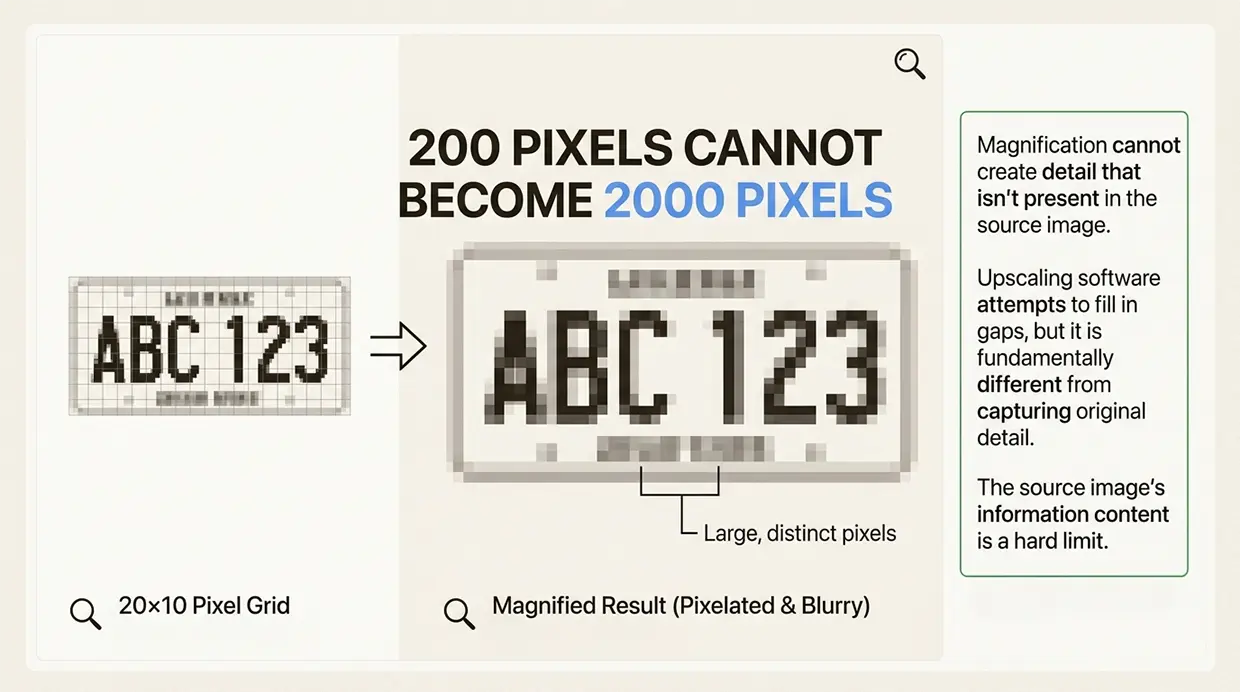
Here's the bottom line:
If the detail was never captured by the camera, no amount of enhancement can recover it.
Better technology will not solve this fundamental limitation. A more advanced camera could have captured the detail, but once the recording is made with a low-resolution device, the opportunity is lost. We work with what exists, not what we wish existed.
What real enhancement looks like
Professional video enhancement relies on established signal processing techniques. Each method has specific applications and limitations.
Signal-to-noise ratio improvement separates the meaningful visual information (signal) from random visual interference (noise). This can reveal details obscured by graininess or compression artifacts.
Temporal filtering analyzes multiple frames over time. Because noise is random while actual scene details remain consistent, averaging frames can reduce noise while preserving real information.
Spatial filtering examines relationships between adjacent pixels to sharpen edges or reduce blur. Different filters address different types of distortion.
Color correction adjusts white balance and exposure to compensate for poor lighting conditions. This can reveal details hidden in shadows or washed out by bright light.
Deinterlacing processes interlaced video (common in older CCTV systems) to create clean, progressive frames without the comb-like artifacts that interlacing produces.
Frame rate normalization addresses timing issues and creates smooth playback from variable frame rate sources.
Every step in forensic enhancement must meet three requirements:
- Documented - Every filter applied, every parameter changed, must be recorded
- Repeatable - Another analyst following the same steps should get the same results
- Non-destructive - The original file remains untouched; all work happens on copies
Forensic tools like Amped FIVE automatically generate reports documenting every step of the enhancement process. This documentation is essential for court admissibility. Consumer editing software like Photoshop or Premiere does not provide this level of scientific rigor.
Where video enhancement helps (and where it fails)
Understanding when enhancement works and when it does not saves time, money, and disappointment.
Video enhancement helps when you need to:
- Clarify movement or sequence of events - determining who moved where and when
- Improve visibility in low-light footage - bringing out details hidden in shadows
- Identify object presence - confirming whether an object or person was present (not who they are)
- Reconstruct timelines - establishing the order of events from multiple camera angles
- Correct aspect ratio distortion - fixing the stretched or squashed appearance common in CCTV footage
Video enhancement cannot help when:
- Faces are blurry - if the camera lacked resolution to capture facial features, enhancement cannot create them
- License plates are unreadable - heavy compression or distance often makes plates permanently unrecoverable
- Heavy compression has been applied - the discarded data is gone forever
- The camera missed the event entirely - enhancement requires something to enhance
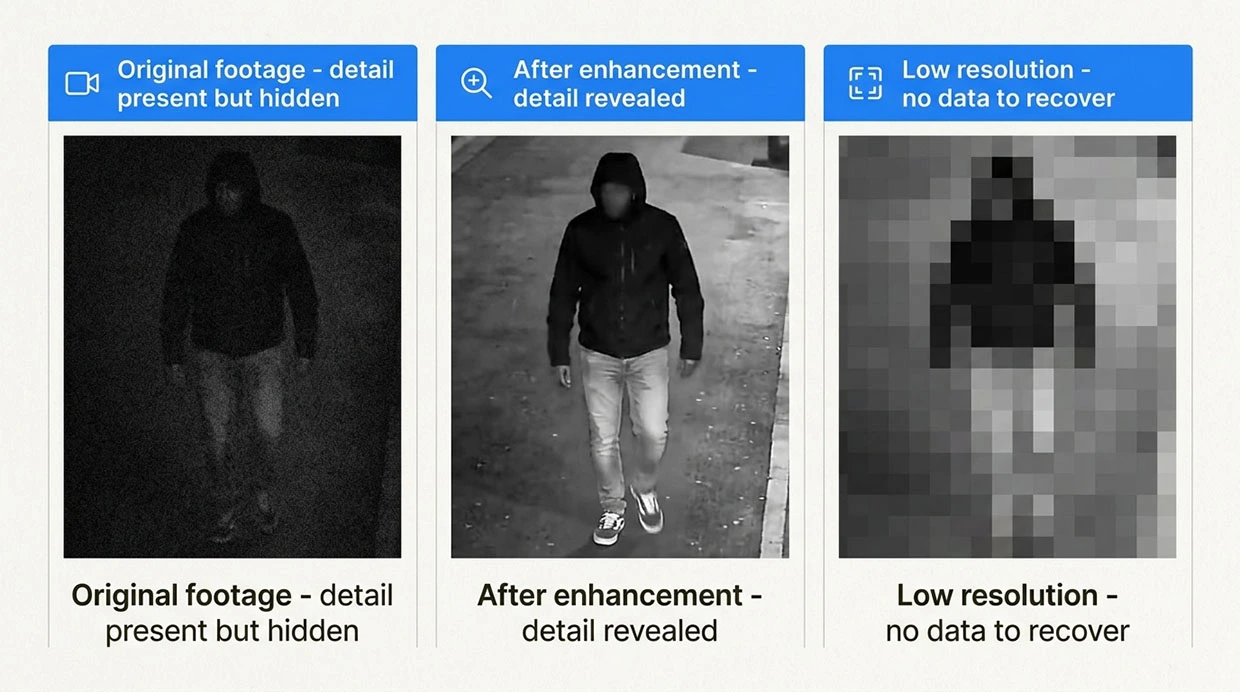
Here's a truth every attorney needs to understand: Video enhancement can clarify truth, but it cannot create it.
We can often determine that a person was present, what they were wearing, and how they moved. We usually cannot determine their identity from low-quality footage. We can often read a license plate that is slightly blurry but legible. We cannot read a plate that appears as a white rectangle with no discernible characters.
AI and video enhancement: a warning
Artificial intelligence has entered the video enhancement space, and it brings both opportunities and serious risks for forensic work.
AI tools can "fill in" details using machine learning models trained on millions of images. Show an AI a blurry face, and it can generate a sharp, detailed face. The result looks impressive. It is also completely inadmissible as evidence. However, sometimes when all other options are gone an investigator can use that to try and develop other leads during an investigation.
This is generation, not recovery.
The AI is not revealing what was actually there. It is inventing what it thinks should be there based on patterns in its training data. The enhanced face may look plausible, but it is not the face that was actually in front of the camera.
Understanding the distinction between restoration-focused AI and regenerative AI is critical:
- Restoration-focused AI works within defined mathematical models to remove noise, sharpen, or deblur without adding new content. This can be forensically valid if properly validated.
- Regenerative AI uses techniques like variational autoencoders and stable diffusion to fill gaps with newly created elements. This poses serious risks to forensic authenticity because the AI is inventing details that were never captured.
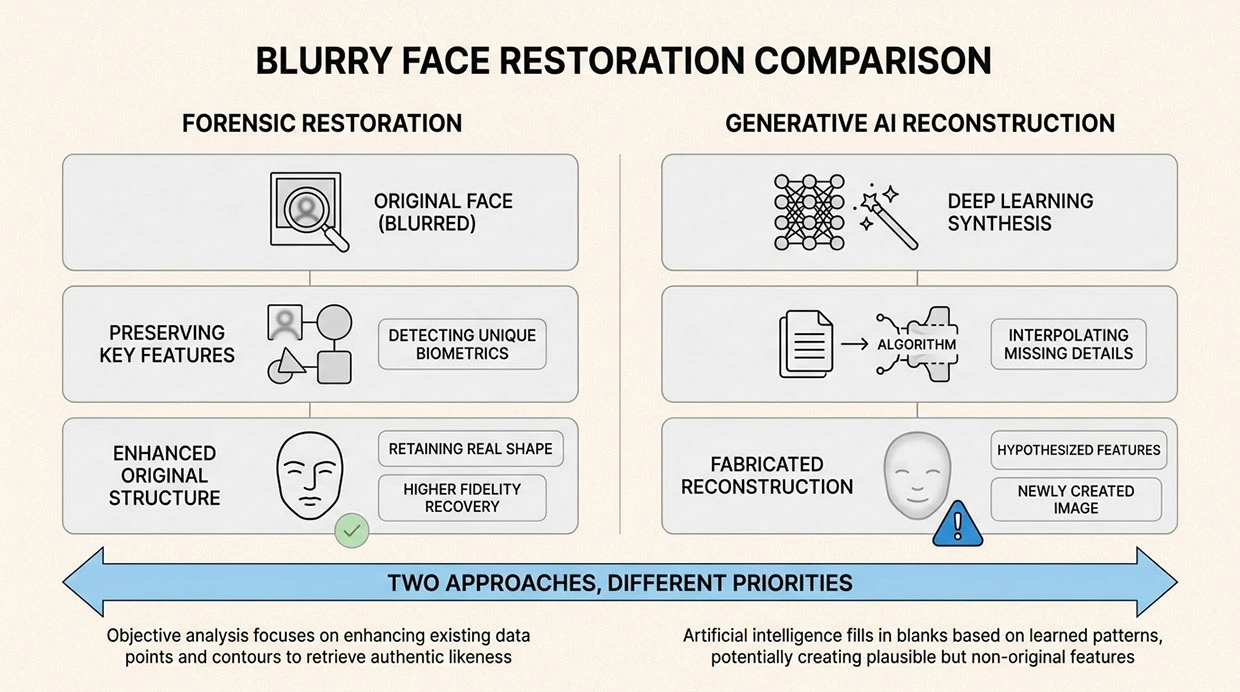
If a tool is inventing pixels, it is no longer evidence. It is interpretation.
The Coalition for Content Provenance and Authenticity (C2PA) has developed standards for content credentials that help track modifications to digital media. These emerging standards aim to provide transparency about what processing has been applied to video evidence.
Using AI generation on evidence risks complete exclusion from court. No competent forensic analyst will apply these techniques to evidence intended for legal proceedings.
Forensic integrity: why methodology matters
Every step in video forensic analysis must be defensible in court. This is not optional. It is the foundation that makes the work admissible as evidence.
The original file must be preserved untouched. We verify its integrity using hash values, cryptographic fingerprints that detect even a single changed bit. If the hash of a file does not match the original, something has been altered.
All analysis happens on working copies. The original remains sealed, available for independent verification by opposing experts.
Expert testimony requires explaining not just what was done, but why. The methodology must be scientifically accepted. The results must be reproducible. The analyst must be qualified.
Consumer editing tools lack the documentation and scientific validation required for forensic work. You cannot simply import evidence into Photoshop, apply some filters, and present the result in court. The opposing attorney will (correctly) tear that approach apart.
Professional forensic software like Amped FIVE generates detailed reports showing every filter applied, every parameter changed, and the scientific basis for each technique. This documentation is essential for establishing the reliability of the enhancement.
What to do if you have video evidence
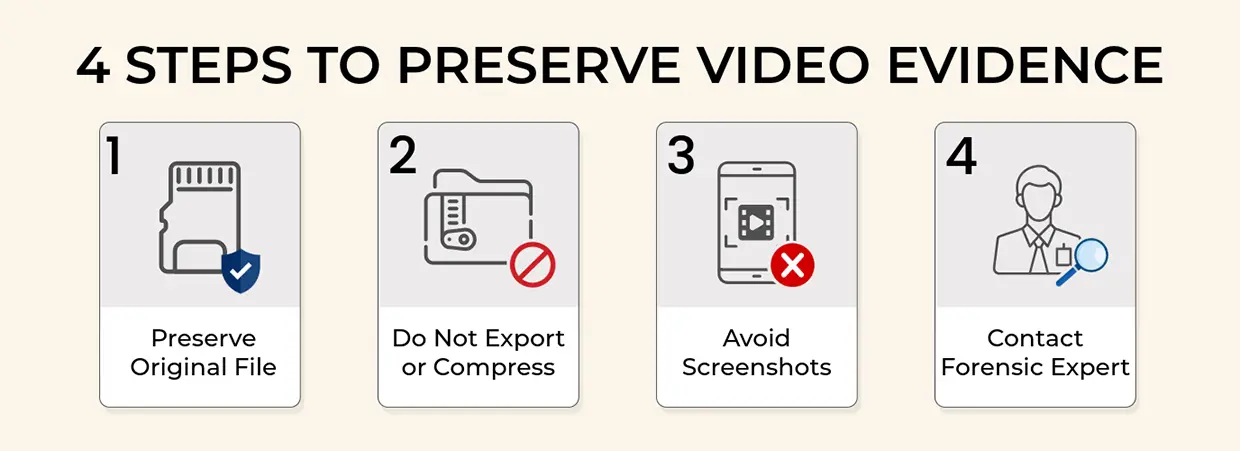
If you have video evidence that might be important to a case, follow these steps immediately:
Step 1: Preserve the original file.
Get the original recording from the camera system, not an export or copy. The original contains the maximum available information and the most reliable metadata.
Step 2: Do not export, compress, or edit.
Every conversion loses information. Do not let anyone "make a copy" using consumer software. Do not upload to cloud services that re-encode files. Do not edit the video "just to see it better." Do not send the video via email or a text message, which also compresses the data.
Step 3: Avoid screenshots.
Screenshots capture what is on screen, not the underlying video data. They discard timing information, metadata, and often significant quality. They are not a substitute for the actual video file.
Step 4: Engage a forensic expert early.
The sooner a qualified video forensic analyst examines the evidence, the better. We can advise on what is realistically possible, prevent mistakes that destroy evidence value, and ensure proper chain of custody documentation.
Common mistakes that destroy evidence value:
- Letting someone "clean up" the video before seeking professional help
- Uploading to social media or messaging apps that re-encode files
- Taking screenshots instead of preserving the original
- Waiting until the last minute before trial to seek enhancement
Getting expert video forensics help
Knowing when to engage a forensic expert can save your case. Contact a qualified video forensic analyst when:
- Video evidence is central to your case strategy
- The footage quality makes important details difficult to see
- Authentication of the video is questioned
- Opposing counsel may challenge the evidence
- You need to present video clearly to a jury
What should you look for in a video forensics provider? Look for:
- Proper training and certification in forensic video analysis
- Experience testifying in court as an expert witness
- Use of scientifically validated tools and methodologies
- Clear documentation of all processes applied
- Membership in professional organizations like SWGDE
At Black Dog Forensics, we specialize in video forensics for legal proceedings. Our analysts are trained on industry-standard tools like Amped FIVE and follow established protocols from SWGDE and NIST. We provide clear, defensible analysis that holds up under cross-examination.
We have testified as expert witnesses in cases ranging from criminal defense to civil litigation. We understand what attorneys need: clear answers about what the video shows, what it does not show, and whether enhancement can help.
If you have video evidence and need to know what is possible, contact us for a consultation. We will give you an honest assessment of what can be achieved, what cannot, and how to proceed.


