


 346-200-6097
Why Workplace Relationships Become a Business Risk

It is a question more business owners are asking than you might think.
My manager slept with an employee, now what?"
But the real issue is not the relationship. It is the risk that comes with it: harassment claims, retaliation allegations, data access concerns, and a digital trail that can either protect your business or destroy your defense.
Most companies wait too long to act. By then, the evidence is gone, the narrative is set, and the damage is already done.
Digital forensics is what separates a controlled response from a costly mistake.
Why Does This Become a Legal Problem (Fast)
Here is what most business owners do not understand: the relationship itself is rarely the lawsuit. What surrounds it is.
When a manager has a relationship with a subordinate, they have created a textbook power imbalance. That imbalance creates legal exposure in several ways:
Harassment claims
Even if the relationship was consensual, the employee can later claim coercion, favoritism, or a hostile work environment. Other employees can claim third-party harassment if they believe the relationship affected their opportunities.
Retaliation risks
If you discipline or terminate either party, you now face retaliation claims. In 2024, retaliation remained the most frequently cited complaint with the EEOC. The risk is not just from the employee in the relationship. It is from anyone who believes they were treated differently because of it.
Favoritism perceptions
Even if no actual favoritism occurred, the perception poisons team dynamics. Other employees disengage. Morale drops. Productivity suffers. And you may not even know why until it is too late.
Wrongful termination exposure
If you terminate the manager or employee without proper documentation, you have handed them a lawsuit. Courts have awarded millions in cases where employers acted on relationship rumors without evidence.
The financial reality
The average cost to defend an employment lawsuit now exceeds $150,000, and that is before any settlement or judgment. For small to mid-sized businesses, a single claim can threaten survival. Even meritless claims require expensive defense.
Reputational damage
News travels fast. Glassdoor reviews, LinkedIn posts, and industry chatter can make it difficult to attract talent long after the legal matter resolves. Your company becomes "the place where that happened."
Operational disruption
Investigations consume executive attention. HR spends weeks managing the fallout. Team productivity plummets as employees take sides or worry about their own positions. The hidden costs often exceed the legal bills.
The statistics are sobering. In 2024, discrimination, harassment, and retaliation claims reached 14.7 issues per 1,000 employees, the highest level recorded. And 32% of organizations still lack structured investigation processes, exposing them to substantial legal and reputational risk.
Source: Workplace Investigations in 2025 - Lauth Investigations
The Digital Evidence Most Business Owners Overlook
When we investigate these cases, we are not looking for gossip or rumors. We are looking for data. And data does not lie.
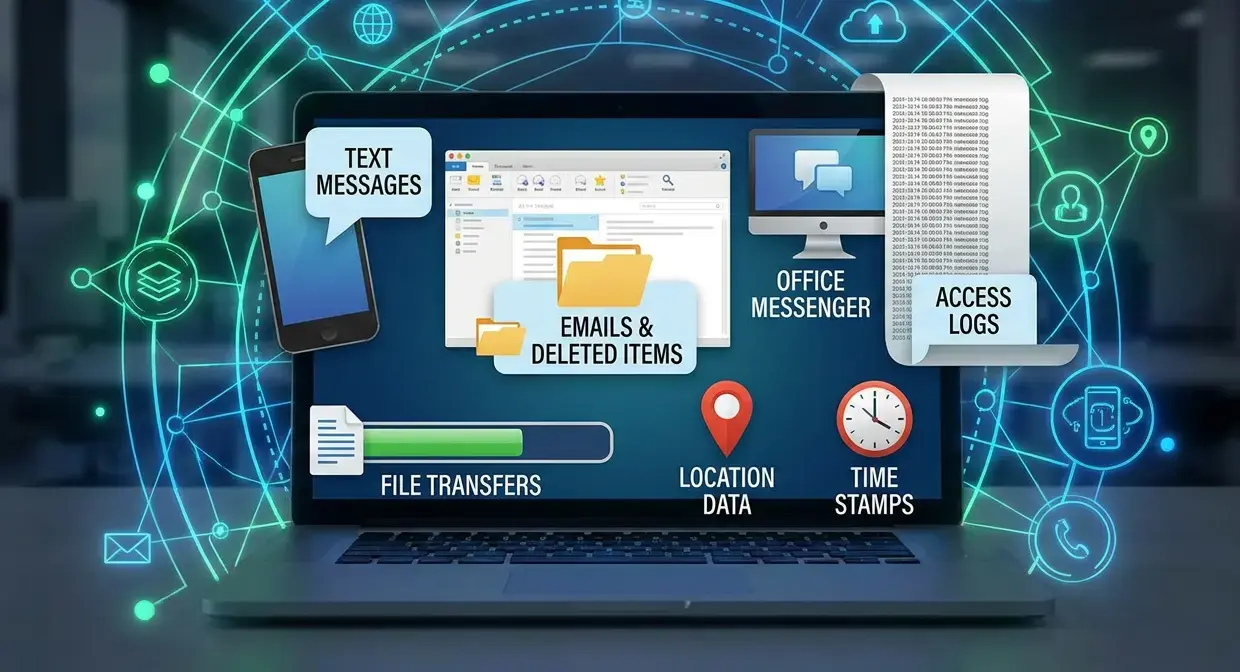
Here is what leaves a trail:
Text messages
Both company phones and personal devices (if your BYOD policy allows access) contain timestamps, content, and sometimes location data. Even deleted messages often leave recoverable artifacts.
Emails and deleted emails
Most employees do not realize that deleting an email does not remove it from the server immediately. Forensic recovery can often retrieve messages the user thought were gone.
Slack, Teams, and internal chats
"Ephemeral" messages are not truly ephemeral. Most enterprise platforms retain logs, backups, and audit trails that persist long after the user interface shows nothing.
Access logs
Who accessed what files, when, and from where. This is often the smoking gun in access or intrusion cases that often accompany relationship investigations.
File transfers
USB device connections, cloud uploads, and personal email attachments. Windows creates artifacts for every device connection, often with timestamps and device identifiers.
Location data and timestamps
Proving patterns of behavior: who was where, when, and for how long.
LNK files and Jump Lists
Windows creates these artifacts automatically when users open files. They persist even after the original file is deleted and can reveal what documents were accessed, when, and from what device.
Everything leaves a trail. Even if deleted. Even if the user thinks they covered their tracks. Digital forensics recovers what standard IT tools cannot see.
What goes wrong (common mistakes)
By the time most companies call us, they have already lost critical evidence.
Here is what we see over and over:
Waiting too long
The employee quits. The manager deletes messages. The IT department runs routine maintenance that overwrites logs. Every day that passes, evidence disappears.
Letting IT "take a look"
Your IT team is skilled at keeping systems running. They are not trained in forensic protocols. One wrong click breaks the chain of custody and renders the evidence inadmissible in court.
Failing to preserve devices immediately
The manager "needs their laptop for work." The employee "has personal photos on their phone." Every minute those devices remain in use is a minute of evidence being overwritten.
Confronting employees before evidence is secured
Once confronted, people get defensive. They delete messages. They warn each other. They lawyer up. You have lost the element of surprise and potentially destroyed your case.
Not understanding the scope of recoverable data
Most business owners have no idea what is actually possible with modern forensics. They assume deleted means gone. They assume personal devices are off-limits. They assume wrong.
Failing to document the decision-making process
When you later need to explain why you took action, vague recollections are not enough. Courts want contemporaneous documentation showing what you knew, when you knew it, and why you acted. Without digital evidence, you have nothing to support your narrative.
Assuming the relationship is "just a personal matter"
This is the most dangerous assumption. Once the relationship affects the workplace or once it ends, the personal becomes professional in the worst possible way. The time to investigate is when you first learn of the relationship, not when the complaint arrives.
The cost difference is stark. A professional forensic investigation done early costs a fraction of what you will spend defending a lawsuit without evidence. Or worse, defending a lawsuit where the other side has evidence, and you do not.
Consider this: A $5,000 forensic investigation conducted in the first 48 hours can prevent a $500,000 lawsuit. But once evidence is destroyed, no amount of money can recover it. The window for preservation is narrow. The consequences of missing it are permanent.
What Digital Forensics Actually Does
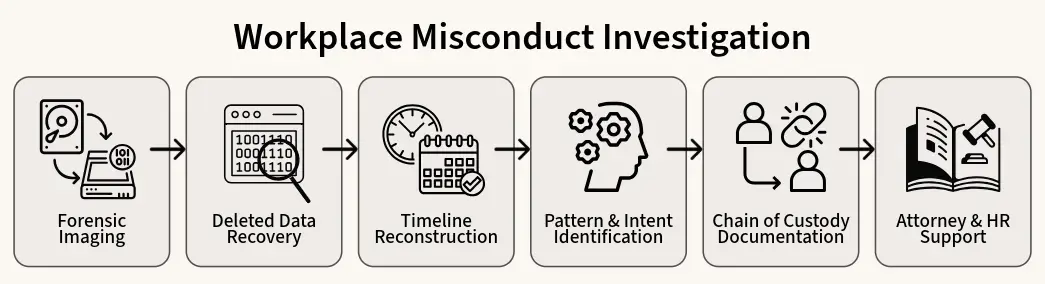
Let us break down what actually happens in a workplace misconduct investigation.
Forensic imaging
We create bit-by-bit copies of digital storage: hard drives, SSDs, phones, and cloud accounts. The original evidence is preserved in its untouched state. We work only on forensic copies.
Deleted data recovery
Files deleted by users often remain in "unallocated space" or "slack space" on storage devices. Specialized tools can recover these remnants even after the recycle bin has been emptied.
Timeline reconstruction
We correlate data from multiple sources, emails, chat logs, file access, and device connections into a chronological view of what happened, when, and in what sequence.
Pattern and intent identification
Was this a one-time mistake or a pattern? Was data accessed for legitimate business purposes or exfiltrated to personal accounts? Timeline analysis reveals intent.
Chain of custody documentation
Every step is documented: who handled the evidence, when, where, and what was done. This documentation is what makes evidence admissible in court.
Attorney and HR support
We provide clear, non-technical reports that attorneys can use in litigation and HR can use in disciplinary decisions. No jargon. Just facts.
The key differentiator: court-admissible standards. Internal IT reviews do not meet legal standards. Forensic investigations do. When you are facing a lawsuit, that distinction matters.
Real Risk Scenarios
These are not hypothetical. These are cases we have seen:
The relationship ends badly
The employee claims the relationship was never consensual, that they felt pressured by their manager's position. Without evidence of the actual communications, you have a he-said-she-said case that often favors the employee.
Third-party harassment claims
Another employee claims the relationship created a hostile work environment for them and that they were passed over for opportunities because of the relationship. You need evidence to prove employment decisions were merit-based.
Sensitive data on personal devices
The investigation reveals the manager accessed the employees’ data without their consent. This is now an intrusion-type case layered on top of the relationship issue.
Retaliation after termination
You terminate the manager for policy violation. They claim it was retaliation for ending the relationship. Without documented evidence of the policy violation and consistent application of that policy, you are exposed.
Social media contradictions
The employee claims emotional distress and damages. Their social media shows vacation photos, new job celebrations, and posts contradicting their claims. This evidence can significantly reduce or eliminate damage.
The quid pro quo scenario
A manager implies that promotion or continued employment depends on maintaining the relationship. When the relationship ends, so does the favorable treatment. The employee claims the relationship was never truly consensual, given the power differential. Without communications showing the true nature of the interactions, the company cannot prove the relationship was welcome.
The data exfiltration case
During the relationship, the manager shared confidential information with the employee client lists, pricing strategies, and product roadmaps. After a messy breakup, that information appears at a competitor. Forensic analysis can prove what was accessed, when, and whether it was transferred to unauthorized accounts.
The pattern of behavior
One relationship might be an isolated incident. Multiple relationships with subordinates over time suggest a systemic problem. Digital forensics can reveal patterns that HR records alone cannot show, patterns that matter in punitive damages calculations.
Each scenario has one thing in common: digital evidence either saves the company or sinks it. The difference is whether that evidence was preserved properly and analyzed professionally.
The Timing Problem
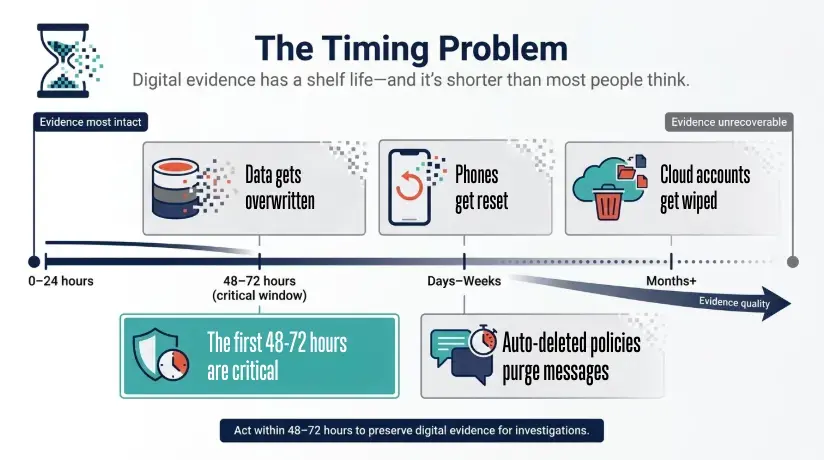
Digital evidence has a shelf life. And it is shorter than most people think.
Data gets overwritten
Normal computer use constantly writes new data to storage. Eventually, deleted files are overwritten and become unrecoverable. The window is often days or weeks, not months.
Phones get reset
"My phone was running slow, so I reset it to factory defaults." We hear this constantly. Once that reset happens, the data is gone.
Cloud accounts get wiped
Employees delete entire email histories or cloud storage folders. Most enterprise platforms have retention policies, but personal accounts often do not.
Auto-delete policies purge messages
Slack, Teams, and other platforms often have automatic deletion settings. Once messages pass the retention window, they are gone unless specifically preserved.
The first 48-72 hours are critical
This is when evidence is most intact, before users have time to cover tracks, and before routine system maintenance overwrites data.
If you suspect a manager-employee relationship is creating legal exposure, the time to act is now. Not after the employee files a complaint. Not after you have talked to your attorney. Now.
What a Business Owner Should Do Immediately
If you find yourself facing this situation, here is your action plan:
1. Do not ignore it
Hoping the problem goes away is not a strategy. It is negligence. The longer you wait, the worse your position becomes.
2. Do not conduct informal reviews
No "quick checks" by IT. No "let me see your phone" conversations. These actions compromise evidence and create liability.
3. Preserve devices immediately
Company laptops, phones, and tablets should be secured. If your BYOD policy allows, preserve personal devices used for work as well. Document the chain of custody from the moment of collection.
4. Engage a forensic expert early
Before evidence is compromised, before users have time to delete data, before the situation escalates. Early intervention is always cheaper than crisis response.
5. Coordinate with legal counsel
Attorney-client privilege protects your investigation. Work with counsel to ensure your forensic investigation supports your legal strategy, not undermines it.
6. Prepare for the aftermath
Regardless of what the investigation finds, you will need to act. Have your attorney review employment agreements, handbook policies, and past disciplinary precedents before you make decisions. Consistency in the application of policy is your best defense against discrimination claims.
7. Communicate carefully
What you say to employees, to the board, to outside parties can become evidence. Draft communications with legal counsel. Avoid admissions, apologies, or speculative statements. Stick to facts and policy.
8. Document everything
From the moment you learn of the relationship, document what you know, what you did, and why. Contemporaneous documentation carries more weight than reconstructed memories. This includes preserving not just digital evidence, but also your own notes and decision-making process.
Source: Third-Party Investigations: Employer Risk - WorkShield
How Black Dog Forensics Protects Your Business
We have seen this scenario many times. The pattern is predictable. So is the solution.
At Black Dog Forensics, we specialize in workplace misconduct investigations that meet court-admissible standards. Our process is designed for business owners who need answers fast, without the technical jargon.
Rapid response
We can often begin evidence preservation within hours of your call. Because we know digital evidence does not wait.
Court-admissible standards
Every investigation follows rigorous protocols for evidence preservation and chain of custody. Our findings have been featured on Dateline and NBC's Karamo. They hold up in court.
Clear communication
We translate technical findings into clear narratives that attorneys, HR professionals, and business owners can understand and act on.
Decades of experience
We have helped businesses contain risk early, before situations escalated to litigation. And we have helped businesses defend themselves when litigation was unavoidable.
The difference between a manageable situation and a six-figure problem often comes down to one thing: when you decide to act.
If you are facing a manager-employee relationship issue, do not wait until the evidence is gone. Contact Black Dog Forensics today.

