


 346-200-6097
How Legal Adult-Content Categories Become Misleading Courtroom Evidence

Imagine a jury hearing the phrase, "The defendant searched for 'young.'" They see the word projected on a screen in 48-point font. They hear the tone of disgust in the prosecutor's voice. What they don't hear is what the data actually shows.
In certain criminal prosecutions, prosecutors are increasingly using pornography-related web history from legal, mainstream adult sites to paint defendants as predators. The narrative sounds damning: "He searched for young." "He was looking at teen content." "He sought out stepmom videos." But when you dig into the forensic reality, the story these artifacts tell is often very different from the story being told in court.
Here's the uncomfortable truth that every criminal defense attorney needs to understand: in digital forensics, what something looks like is often very different from what it is.
At Black Dog Forensics, we've encountered this issue in numerous forensic reviews. Browser history evidence gets mischaracterized. Category clicks become "searches." Thumbnail selections become "targeted queries." And defendants face character assassination based on routine, legal adult porn use driven by algorithms, not deviant intent.
How Adult Websites Actually Work
To understand what browser history actually means, you need to understand how adult sites are structured. This isn't prurient; it's the technical context that every defense attorney needs.
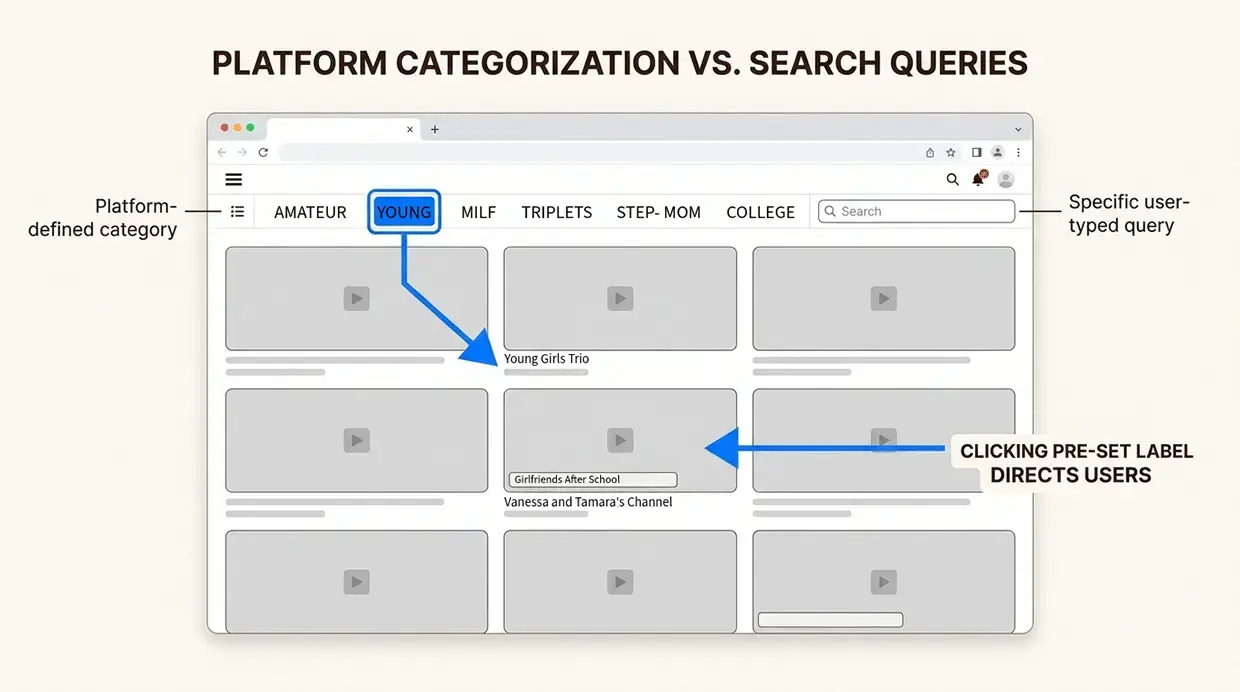
Categories are pre-built platform labels
When you visit a major tube site like Pornhub, Xvideos, or Xnxx, you're not encountering user-created search terms. You're seeing platform-defined categories: "Young," "MILF," "Hot," "Amateur," and thousands of pornstar names. These are organizational labels, not evidence of what a user typed.
A user can click a category thumbnail without ever typing a single word. The category "Young" might display thumbnails of performers who are clearly in their mid-20s. But the click gets logged, the URL gets recorded, and later it becomes "the defendant searched for young."
Thumbnails drive behavior
Users respond to images and layout, not text labels. Someone browsing an adult site often clicks the picture that catches their eye, not the text label that later gets quoted in court. A user might click a photo of a clearly adult performer that's tagged with the category "Young," not because they were seeking anything specific, but because the image was visually compelling.
Titles are misleading by design
Video titles on adult sites are user-generated or studio-generated, designed for click-through optimization. They often reference trending themes, "stepmom," "teen," "young," "first time," regardless of whether the actual content matches those descriptions.
We've tested this: clicking the "Hot" category on a major tube site can return videos with incest-themed titles that the user never explicitly sought out. The title is sensationalized marketing, not documentary evidence of the user's interests.
Algorithms can push content constantly
Related videos, recommendations, sidebars, autoplay, and "because you watched X" mechanics constantly present new content that the user didn't search for. A user might watch one video and have five more queued automatically. Each of those videos generates a URL in the browser history, even though the user never chose to view them.
Here's the key takeaway: users are often presented with content they never searched for. They simply encountered it because the platform put it in front of them.
It's also critical to understand that these mainstream platforms are not lawless corners of the internet. Pornhub, Xvideos, and Xnxx all operate with explicit Terms of Service and content control policies that prohibit CSAM and commit to cooperating with law enforcement. They use hash-matching technology similar to Microsoft's PhotoDNA to detect known CSAM. They maintain Trust and Safety teams. They comply with 18 U.S.C. § 2257 record-keeping requirements. These are public-facing, legally operated adult entertainment platforms, not underground networks or dark websites.
When a defendant's browser history shows visits to these platforms, it shows access to mainstream sites with active content moderation and legal compliance frameworks. That's a very different picture than the one typically painted in court.
The critical distinction: search vs. click vs. exposure
Let's break down the hierarchy of user intent versus passive exposure:
Search equals an intentional query typed by the user. This is what prosecutors imply when they say "he searched for young." A true search involves typing keywords, hitting enter, and receiving results based on that specific query.
Click equals a reaction to what is visually presented. This might be clicking a thumbnail, a category label, or a related video. The user made a choice, but it was a choice from options presented to them, not a self-directed search.
Exposure equals what the platform shows or recommends, regardless of user request. This includes autoplay videos, sidebar recommendations, homepage suggestions, and algorithmic "because you watched" content.
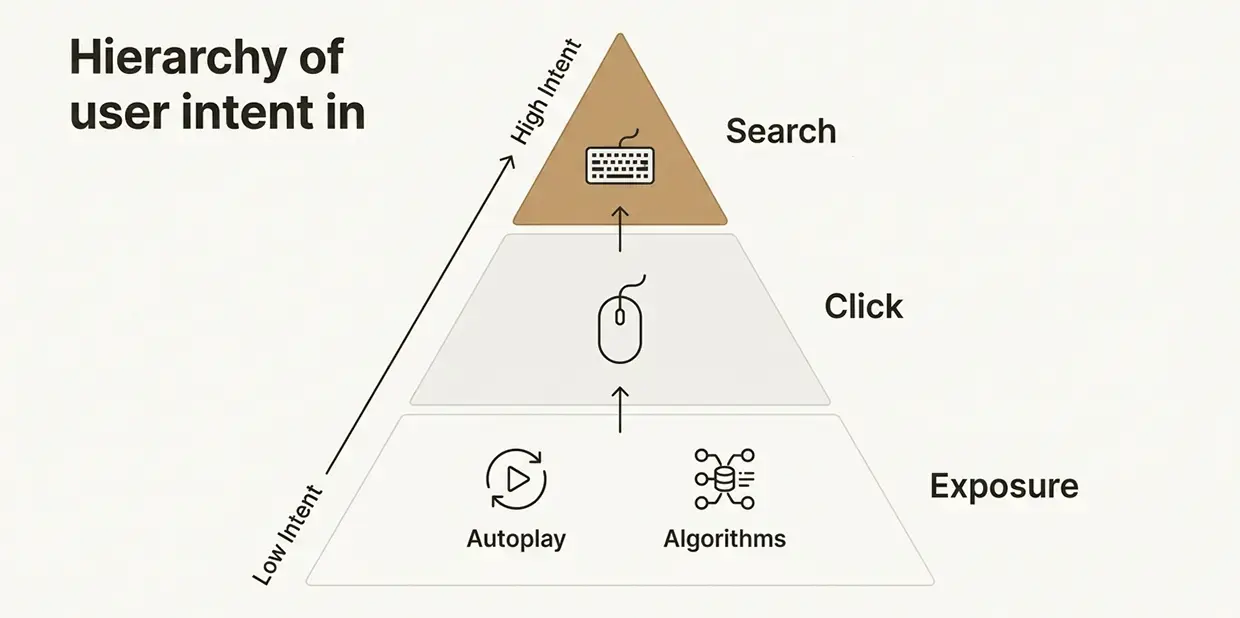
Most forensic artifacts in these cases do not cleanly distinguish between these three states. Yet in court, they are often collapsed into a single narrative: "intent."
Here's the technical reality: many artifacts only show that a URL existed on the device or that a page may have been loaded. They don't prove the user typed in a particular term. They don't establish that the user knowingly sought out a specific theme. They don't even prove the user watched the full video. A URL in browser history is not a confession; it's just data that requires interpretation.
Not all digital activity reflects intent; sometimes it reflects what was placed in front of the user.
How this gets misrepresented in court
The prosecutorial playbook in these cases follows a predictable pattern. You'll hear phrases like:
- "He searched for..."
- "He was viewing..."
- "He was looking at 'young'..."
- "He sought out teen content..."
Now contrast that language with what the artifacts actually show:
- A carved URL from unallocated space with no timestamp
- No account linkage or user attribution
- A click on a thumbnail within a generic category page
- A video that autoplays after another video ends
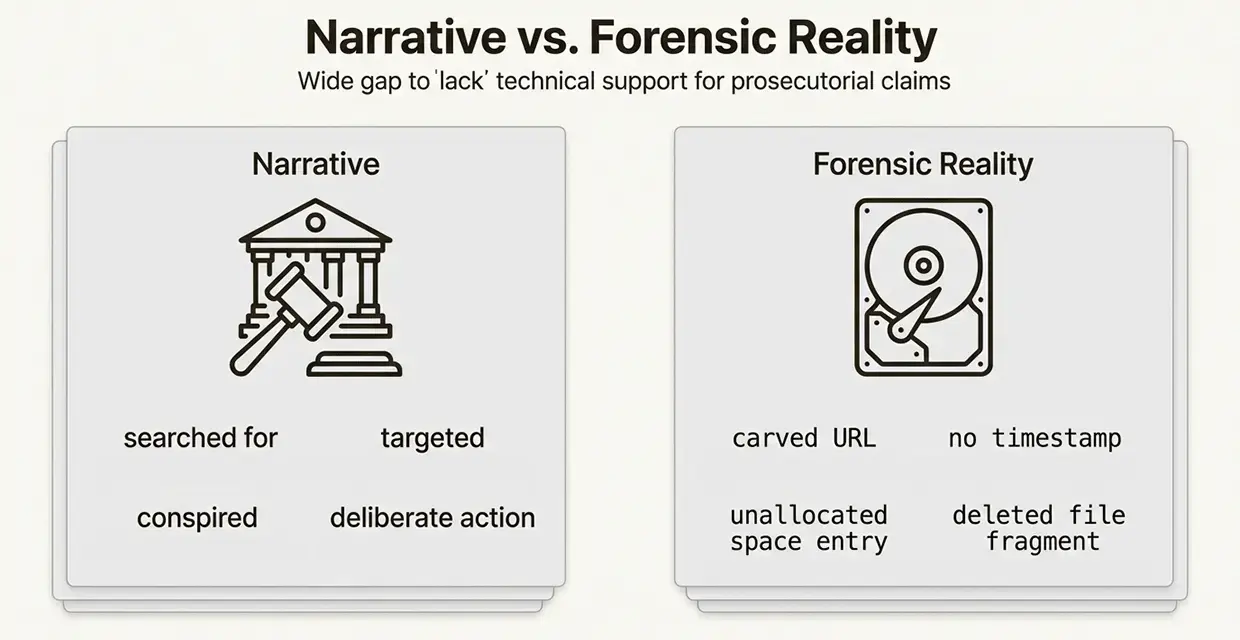
Without proper context, it's easy to slide from "a URL exists in unallocated space" to "the defendant intentionally searched for this," even though that inference isn't supported by the technical evidence.
When context is removed, assumption fills the gap. An assumption is not evidence.
There's another dynamic at play here, particularly in conservative jurisdictions. In Bible Belt communities and other areas where public discussion of sexuality is limited, jurors may publicly condemn looking at mainstream pornography even though private behavior often differs.
Many jurors look at porn themselves but would be ashamed to admit it or stand up for a defendant because of their own discomfort. This creates an environment where "porn = bad character" goes largely unchallenged, and where the technical nuances of digital forensics get overwhelmed by moral discomfort.
The result? Character assassination disguised as digital evidence.
Why this matters: legal and human impact
Let's step back from the technical details and look at what's actually at stake.
Jury perception is driven by emotional reaction
When a prosecutor projects the word "young" on a screen and says it with disgust, they're triggering an emotional response that can overwhelm careful forensic analysis. The word sounds sinister. The implication is clear. But the forensic reality that "Young" is a platform category containing adult performers gets lost in the reaction.
The risk is character assassination outweighing probative value
Under Federal Rule of Evidence 404, evidence of other acts isn't admissible to prove character. But prosecutors routinely use legal adult pornography browsing to suggest "deviant character" or "predatory tendencies." The content being discussed is legal mainstream adult pornography, not CSAM. Yet it's being deployed to paint defendants as depraved.
The reality is that people masturbate
Viewing legal adult pornography on public, mainstream sites is a common, lawful behavior. It does not, by itself, prove criminal intent or propensity. It certainly doesn't prove intent to possess CSAM. People use these sites for sexual gratification; that's what they're designed for. That's not a crime.
The difference between a category label and criminal intent is not a technicality. It is the foundation of a fair trial.
When we allow prosecutors to mischaracterize routine adult browsing as evidence of deviance, we create a dangerous precedent. We allow digital artifacts to be stripped of context and weaponized against defendants. We let assumptions substitute for evidence. And we risk convictions based on misunderstood data rather than proven facts.
The forensic standard that should be applied
At Black Dog Forensics, we believe digital evidence must be interpreted within its full technical context, not reduced to a convenient narrative. Here's what a defensible forensic approach looks like:
What should NOT be done
- Drawing sweeping conclusions from isolated URLs
- Ignoring the limitations of unallocated space carving
- Treating category labels as if they were verified search terms
- Presenting carved data as an active browsing history
- Failing to distinguish between search, click, and exposure
What SHOULD be done
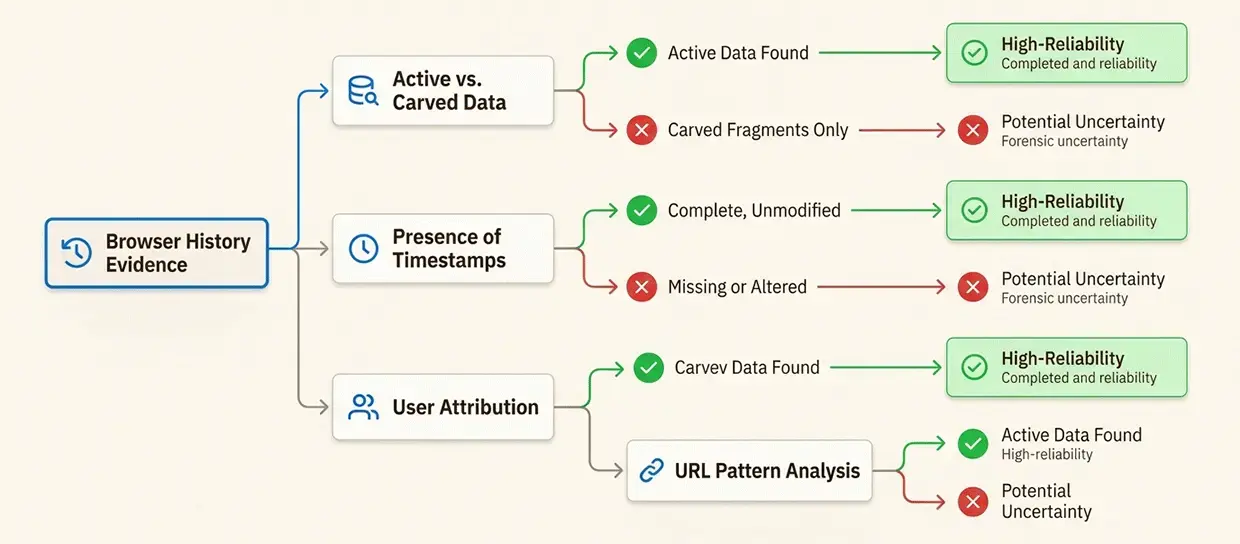
Examine whether there is evidence of true search-pattern URLs. On many tube sites, search URLs follow specific patterns. Just because the URL says “search” does not mean that the user typed in a search term. Determining whether a URL represents a search or a category click often requires live testing of the site. You can't assume you have to verify.
Check for timestamps, user accounts, device usage, and corroborating artifacts. Does the evidence show an active browsing session with a clear timeline? Or just fragmented data carved from disk space? Is there evidence of a logged-in account? Can you establish who was using the device at the time?
Review how the site actually works today. Site structures change. URL patterns evolve. Algorithms shift. What was true six months ago may not be true today. A proper forensic review requires understanding current site architecture, not outdated assumptions.
Pull and review the site's Terms of Service and content policies. Document that these are mainstream adult platforms with explicit CSAM prohibitions. Show that they cooperate with law enforcement. Demonstrate that accessing these sites means accessing legally operated platforms with content moderation, not underground networks.
Part of a proper forensic review is examining the privacy policy and terms for these sites and confirming they are public-facing legal pornography platforms that moderate against CSAM.
At Black Dog Forensics, our computer forensics and user activity analysis services are designed to provide this level of rigorous, context-aware examination. When we review opposing expert reports, we look for exactly these kinds of misinterpretations: the collapse of search into click into exposure, the presentation of carved data as active history, the assumption of intent from platform-defined categories.
Making sure the right story is told
So what does "the defendant searched for 'young'" actually mean? In many cases, it means a human being visited a legal adult website and clicked on a thumbnail while horny. That's it. That's the story. Everything else, the implication of deviance, the suggestion of criminal intent, the hint of something darker, is projection.
The gap between misinterpretation and reality is where cases are won and lost. What sounds sinister in a soundbite may, under forensic scrutiny, simply be evidence of routine adult behavior. What looks like a smoking gun may be a blank.
In the digital world, a single word can be taken out of context. In the courtroom, that misunderstanding can take on a life of its own. The role of digital forensics is not to tell a story. It's to make sure the right one is told.
Contact Us
If you're facing a case where browser history evidence is being mischaracterized, you need a forensic team that understands the technical reality behind the narrative. At Black Dog Forensics, we specialize in uncovering the truth behind digital artifacts. From search and forensic protocol development to expert testimony, we ensure that digital evidence is interpreted accurately and completely.
Because in a fair trial, assumption should never be a substitute for evidence. And the word "young" is just a word until someone gives it a meaning that the data doesn't support. Schedule your free consultation today.

