

 346-200-6097
What Chatrie Means for Defense Attorneys
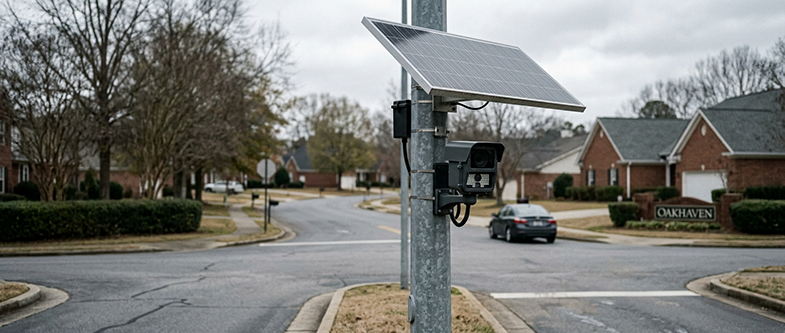
Flock Safety's LPR network captures and shares vehicle location data across jurisdictions with no warrant. A Supreme Court ruling in June 2026 just gave defense attorneys their strongest argument yet against it. Here's the current state of the law, what to demand in discovery, and where the real openings are.
Flock Safety's automated license plate readers are embedded across thousands of communities nationwide. A single commute through a dense suburb can generate 10 to 20 plate reads before your client reaches their destination. Law enforcement doesn't need a warrant to access these reads. Private customers (HOAs, churches, retailers) can share their feeds directly with police with no court order, no judicial oversight, and no resident notice. Flock's National LPR Network allows a read captured in Houston to be queried by law enforcement in another state.
Courts have treated this as settled for years: a license plate on a public road carries no expectation of privacy, so no warrant is required. That's still the majority rule, but it's not as solid as it looked in January. The Supreme Court decided Chatrie v. United States on June 29, 2026, and the reasoning behind every ALPR ruling to date is now open to challenge.
What Flock Safety Is and How the Network Actually Works
Flock deploys fixed LPR cameras at fixed locations: subdivision entrances, HOA gates, retail parking lots, church parking lots, school zones, gas stations, and highway on/off ramps. Each camera reads a license plate as a vehicle passes and captures eight data points: the license plate image, vehicle image, vehicle characteristics (color, make, roof rack presence), the plate number itself, the plate state, the date, the time, and the camera location. That data moves to Flock's AWS-based U.S. cloud infrastructure, encrypted end-to-end, where it's hard-deleted on a rolling 7-day basis by default (a change from the longer retention windows Flock advertised in earlier versions of its policy, so confirm the current figure at the time you're working a case).
The network is not one camera. Flock operates a National LPR Network that enables cross-jurisdictional queries, meaning law enforcement in one state can search a plate read in another.
Private customers own most of these cameras. HOAs, businesses, churches, and retail centers all purchase Flock systems, and under Flock's LPR Policy, these private customers can choose to share their data with law enforcement with no warrant, no court order, and no resident notice. The data belongs to the private customer, not to Flock, and the private customer decides who gets access. This is not a law enforcement system with built-in judicial oversight. It's a private-to-law-enforcement data pipeline.
What Flock Data Actually Captures, Beyond the Plate
The plate read is the obvious forensic artifact. The real intelligence lives in aggregation. Even inside a 7-day window, a vehicle that passes multiple cameras daily generates a real pattern, not a single data point.
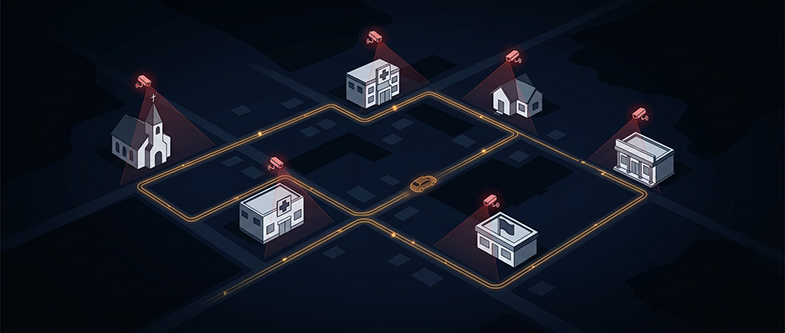
Restaurant and retail cameras capture entry and exit times that can reconstruct routine and habits. Church parking lot cameras feed into the same shared network, raising an associational-privacy question that has barely been litigated in Texas: a vehicle repeatedly captured at a mosque, synagogue, or evangelical church reveals religious affiliation and attendance patterns gathered with no legal threshold at all. A vehicle consistently leaving a residence at 6 a.m. reveals who's coming and going. Cameras near medical office parks, oncology centers, addiction treatment facilities, and mental health clinics capture entry and exit times that establish medical patterns without anyone ever seeing a medical record. Cameras near campaign offices, union halls, and rally locations capture political activity. Cameras near payday lenders and bankruptcy law offices sketch a financial picture.
Carpenter v. United States held that the government cannot compel disclosure of a person's cell site location information without a warrant, because the cumulative record reveals a comprehensive chronicle of someone's movements. Until this June, courts uniformly held that Flock-style ALPR data doesn't reach that level, because each read is just a snapshot at a fixed point. That's the assumption Chatrie now puts pressure on.
The Supreme Court Just Moved the Ground: Chatrie v. United States
On June 29, 2026, the Supreme Court decided Chatrie v. United States, 609 U.S. ___ (2026), holding that police violated the Fourth Amendment when they used a geofence warrant to pull Google Location History data from a 150-meter radius around a crime scene. The Court found that accessing this kind of location data is itself a search, extending Carpenter's reasoning to a new category of digital records, and it rejected the government's argument that limiting the request to a narrow time window made the intrusion smaller. The scope of the privacy interest, the Court held, doesn't shrink just because the government can pinpoint exactly which few hours it wants to look at.
That last point is the one that matters here. Every ALPR ruling denying suppression, including every federal case discussed below, rests on the idea that a read is a discrete, momentary snapshot rather than a comprehensive record. Chatrie just told the government that "we only looked at a narrow slice of a comprehensive database" isn't a defense on its own. Civil rights attorneys, including counsel in the pending Fourth Circuit appeal in Schmidt v. City of Norfolk, are already arguing that this reasoning applies directly to ALPR networks: a small fraction of Flock's billions of plate reads may be relevant to any given case, but all of it sits in one queryable, retained database, which is the same structural feature Chatrie found constitutionally significant.
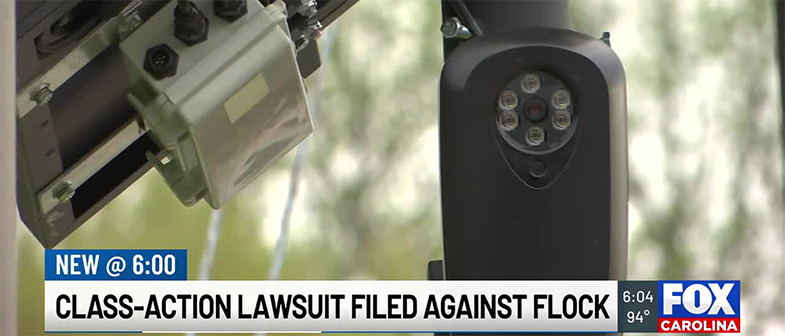
Flock disagrees, and its own public position is worth knowing before you make this argument. The company's position is that Chatrie actually reinforces the legality of ALPR: geofence location history, Flock argues, is continuous and can reveal movement into homes, doctors' offices, and other private spaces, while ALPR only captures discrete observations at fixed points on public roads and can't reconstruct someone's full daily life the way phone location history can. That's a real distinction, and it's exactly the fight now playing out in Schmidt v. City of Norfolk, currently on appeal to the Fourth Circuit after a district judge held Norfolk's Flock deployment constitutional. Sixteen states plus the District of Columbia have filed an amicus brief supporting Norfolk's position, and the ACLU and Cato Institute have both weighed in on the challengers' side. Flock is also facing a nationwide class action separate from the Norfolk litigation.
None of this means suppression motions relying on Chatrie will win. It means the "it's just a snapshot" rationale that every court below has leaned on is no longer as settled as it looked as recently as this spring, and that's a meaningfully different posture to argue from than the one available a year ago.
The State of the Law: What Texas Courts Have Said
Texas courts have been unfriendly to ALPR suppression motions, and the defense bar should know this landscape plainly.
Uhunmwangho v. State, No. 09-19-00119-CR (Tex. App.-Beaumont, Mar. 25, 2020): Fixed ALPR cameras on U.S. Highway 59 operated through Vigilant Solutions, the same private-to-law-enforcement data model as Flock. The court held that photographing a license plate on a public road is not a Fourth Amendment search: plates are exposed to public view, and there's no reasonable expectation of privacy in them. The court distinguished Carpenter, finding that a single ALPR photograph taken during a traffic stop is factually different from long-term cell phone location tracking. This remains the controlling unfriendly authority in Texas, and no Texas appellate court has yet revisited it in light of Chatrie.
Landers v. State, No. 07-21-00197-CR (Tex. App.-Amarillo, Nov. 27, 2023): A critical procedural trap. The defendant was stopped after an ALPR hit flagged an outstanding warrant, then led police on a 60-mile chase and was charged with evading arrest. When he tried to challenge the legality of the ALPR-based stop through a pretrial suppression motion, the court held that was the wrong vehicle. Under Texas Penal Code § 38.04(a), the legality of the detention is an element of the evading offense itself, so the fight belongs at trial during the state's case-in-chief, not in a suppression hearing. If you have an evading charge with a Flock or ALPR stop at the origin, know this constraint before you file.
Texas has no dedicated ALPR privacy statute. No specific law governs Flock Safety data retention, access, or cross-agency sharing in Texas. The only exclusionary mechanism is Texas Code of Criminal Procedure Article 38.23, the state exclusionary rule barring evidence obtained in violation of Texas or federal law.
The Federal Picture: Unfriendly So Far, but Narrower Than It Looks
United States v. Porter (5th Cir.): The controlling federal authority in Texas. The Fifth Circuit held that license plate reader location data, even historical records, doesn't require a warrant because the system provides only periodic snapshots at fixed camera locations rather than continuous tracking. This reasoning has become the standard line across circuits denying ALPR suppression motions, and it's the exact rationale Chatrie now calls into question.
United States v. Jackson (D. Kan.): The clearest federal case naming Flock Safety specifically. The court held that capturing license plate images on public roads using the Flock system doesn't violate the Fourth Amendment, reasoning there's no reasonable expectation of privacy in exterior vehicle features.
United States v. Sturdivant (N.D. Ohio): Rejected an argument to apply Carpenter to ALPR, holding the systems "cannot create an all-encompassing record of movements" the way cell-site location data can. This is the standard rejection, and it's the same "not comprehensive enough" reasoning Chatrie pressures.
United States v. Toombs, 671 F. Supp. 3d 1329 (N.D. Ala.): Denied suppression, characterizing ALPR reads as snapshots at discrete times rather than comprehensive tracking.
United States v. Mapson (11th Cir.): Applied the good-faith exception to warrantless ALPR database access, but the reasoning is narrower than it's sometimes described. The officers accessed the ALPR database before Carpenter was decided in 2018, so the court held they reasonably relied on the law as it stood at the time. That's a fact-specific holding about pre-Carpenter conduct, not a general statement that courts reach for good faith whenever they're uneasy about the underlying Fourth Amendment question. Don't overstate what this case says.
Across these five federal cases, spanning the Fifth, Sixth, Tenth, and Eleventh Circuits, every court that has denied suppression relied on the same "discrete snapshots" rationale. That rationale has a ceiling, and no court has yet addressed what happens when a defendant's plate is captured across dozens of Flock cameras in a network-dense area. The aggregation argument was already worth raising before Chatrie. After it, you have a Supreme Court opinion rejecting the government's closest analogous argument to cite directly.
Where the Real Arguments Live
Frame each of these as an issue to raise, not settled law. Don't overstate: the case law above still runs against you in Texas and most federal circuits. But these arguments are live, and some are stronger than they were even a few months ago.
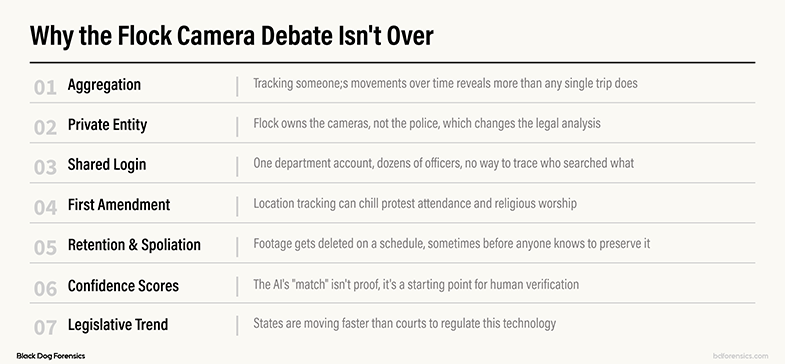
1. The Aggregation Argument, Now With Supreme Court Backing.
No Texas or federal appellate court has yet applied Chatrie's reasoning to a Flock-style ALPR network. The "discrete snapshot" rationale weakens as network density increases, and Chatrie just held that carving a comprehensive database into a narrow query doesn't shrink the underlying privacy interest. A vehicle captured at 15 cameras in a single commute, repeated daily, is a pattern, not a snapshot, and you now have on-point Supreme Court language to argue that aggregation of otherwise-public data points can cross a constitutional threshold.
2. The Private Entity Angle.
Flock cameras are frequently owned by HOAs, businesses, and churches, not law enforcement. Flock's LPR Policy lets these private customers share data with police with no judicial oversight. Uhunmwangho involved a similar private-to-law-enforcement structure, but the court didn't deeply analyze the constitutional implications of that structure itself. Whether a private customer's unilateral decision to share data with police implicates state action, or whether law enforcement's warrantless access to privately owned camera networks is itself a search, remains open in Texas.
3. The Shared Login and Access Control Problem.
Flock's LPR Policy requires logging every query by username, date, time, and purpose, and describes role-based access controls limiting access by functional need. Many smaller departments, often the ones deploying Flock most aggressively, run on shared logins or shared workstation credentials. If that's the case, the audit log can't establish which officer ran the query or whether it served an authorized purpose, and Flock's own documented policy requirements become unverifiable. Demand the department's actual account structure: how many individual logins exist, whether credentials were shared, and the shift assignment tied to the specific login that queried your client's plate. If the government can't establish who ran the query or why, that's a reliability argument, and if shared logins were in use, Flock's own policy framework was violated in practice.
4. First Amendment Associational Privacy.
Passive capture of religious attendance, political activity, and medical appointments implicates interests beyond the Fourth Amendment. These arguments haven't been raised in the ALPR context in Texas, and a defendant with vehicle captures at politically or religiously sensitive locations has an undeveloped constitutional claim worth preserving.
5. Retention and Spoliation, and the Clock Is Shorter Than People Think.
Flock's default retention is now 7 days, not the 30-day window sometimes cited in older commentary. If law enforcement failed to preserve potentially exculpatory reads (data placing your client elsewhere, or inconsistent with the state's timeline) before that 7-day window closed, you may have a Brady issue and a Texas Code of Criminal Procedure Article 38.23 argument. Move immediately: a shorter retention window means less time to act, not more. If retention was extended, Flock's policy requires approval from an elected official or governing body before extending beyond the default; demand documentation of that authorization.
6. Accuracy and Confidence Scores.
Flock's own policy acknowledges that plate translation "may be incomplete or inaccurate" and that the system assigns an internal confidence score to every read, filtering out low-confidence reads before they reach a user. Reads just above that threshold are sent to officers, and the actual confidence score is almost never disclosed in discovery. That score tells you how reliable the OCR was for that specific read. Demand it in every case. If it's unavailable, that's grounds for a reliability challenge to the platform itself.
7. The Legislative and Litigation Trend.
Other states are moving to restrict ALPR data sharing and retention. Texas has no comparable statute. Meanwhile, Flock is defending a nationwide class action and an active Fourth Circuit appeal in Schmidt v. City of Norfolk. When other jurisdictions are tightening what Texas still allows, and the industry's flagship vendor is defending on multiple fronts at once, that's relevant context for why a court should look harder at the status quo rather than assume it's settled.
What Flock's Own Policies Reveal, and What to Demand in Discovery
This section draws on Flock's current LPR Policy and Evidence Policy, both of which Flock updates periodically. Confirm the live version and its effective date before you cite it in a filing; the specific dates and even specific figures (like the retention window) have changed more than once.

What to Demand in Every Flock Case:
The complete query audit log for the relevant period: username, date, time, stated purpose, and the plate or elements used to query. If it's missing or incomplete, the government hasn't complied with Flock's own documented standard, and the absence of that evidence is worth raising as a Brady issue.
The department's user account structure: how many individual logins exist, whether shared credentials were used, and the shift assignment tied to whichever login ran the query on your client's plate.
The confidence score and internal flag data for the specific read at issue, not just the final output. Flock's policy confirms the system filters low-confidence reads internally; the score behind a given read is what tells you how reliable it actually was.
The applicable retention period for that specific municipality or customer: the current 7-day default, or an extended period. If extended, demand documentation of which elected official or governing body approved it and when.
Camera health logs for the 24-hour window around the incident. A camera that dropped LTE connectivity and resynced can produce a timestamp that isn't reliable.
The chain-of-custody documentation and certification method for the specific evidence produced, and whether it was downloaded before or after July 1, 2025, since Flock's Evidence Policy applies different authentication procedures on either side of that date.
Documentation of every agency with access to the camera network that captured your client's plate, including cross-agency sharing and National LPR Network participation.
The complete list of Flock cameras that captured your client's vehicle during the retention period, not just the single frame cited in the police report. If the system holds a week (or more) of your client's movements, the defense is entitled to the full pattern, not just the frame law enforcement chose to disclose. This is the aggregation argument in practice: you want the whole record to make the Chatrie-style case.
On serving legal requests directly on Flock: Flock's Evidence Policy states that non-law-enforcement requests must be served on Flock's registered agent, and that Flock uses a platform called Kodex to receive and track legal requests. Confirm the current registered agent name and address directly with Flock or through a corporate filings search before serving anything; that detail changes and getting it wrong means a subpoena that never arrives. The policy also gives Flock 14 calendar days' notice before it will produce a witness for testimony, and reserves the right to reject requests that are vague, overbroad, or lack a legal basis, so keep any request tight and specific.
After the retention window closes, the data is gone. If law enforcement failed to preserve reads that may have been exculpatory before that 7-day (or extended) window ran, that's a spoliation argument and a potential Brady violation. The clock starts at the date of capture, not the date you request discovery. Move fast.
Black Dog Forensics: Understanding the Evidence
When you receive Flock data in discovery, you're receiving a piece of a much larger infrastructure built to track vehicle movements across state lines. A single plate read looks like a photograph and a timestamp. Behind it sits a retention policy that's shorter than most people assume, a shared national network, a confidence score filtered out before it reaches you, an audit trail that may be compromised by shared credentials, and now, a Supreme Court decision that's actively reshaping how courts think about aggregated location data.
The discovery demands here are specific to how Flock actually operates today, not how it operated a year ago. Use them, and expect the legal landscape around this technology to keep moving faster than the case law citations in any article, including this one.
How Black Dog Forensics Helps
We build our examinations around how Flock evidence actually behaves today, not around a policy snapshot that goes stale in a few months. That means checking the current retention window, pulling the audit trail, and knowing which legal arguments have Supreme Court support behind them and which are still speculative. If Flock evidence has shown up in your case, it's worth a conversation before you accept the government's account of what it shows.
Schedule a consultation with Black Dog Forensics today.

