


 346-200-6097
The Limits of Video Evidence in Plate Identification
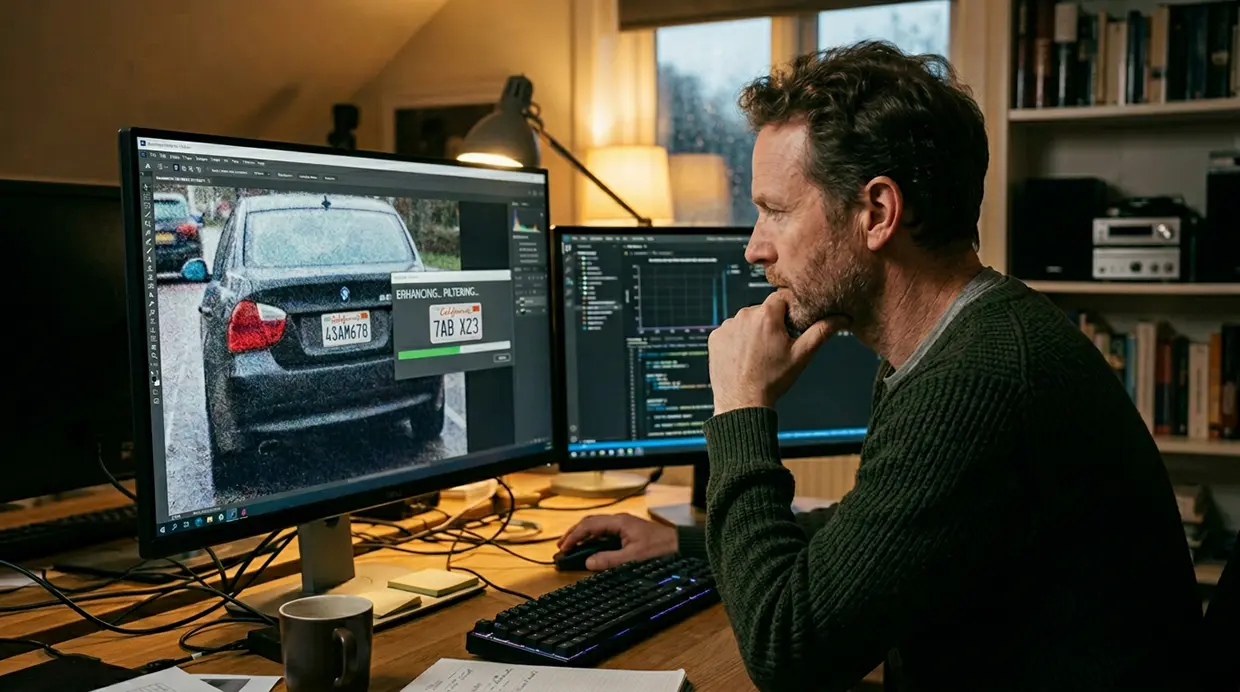
A vehicle passes through a parking lot camera. Something happens. Investigators pull the footage and ask the question they always ask: "Can we enhance the license plate?"
The answer is not as simple as most people expect. In fact, it is often the answer they do not want to hear.
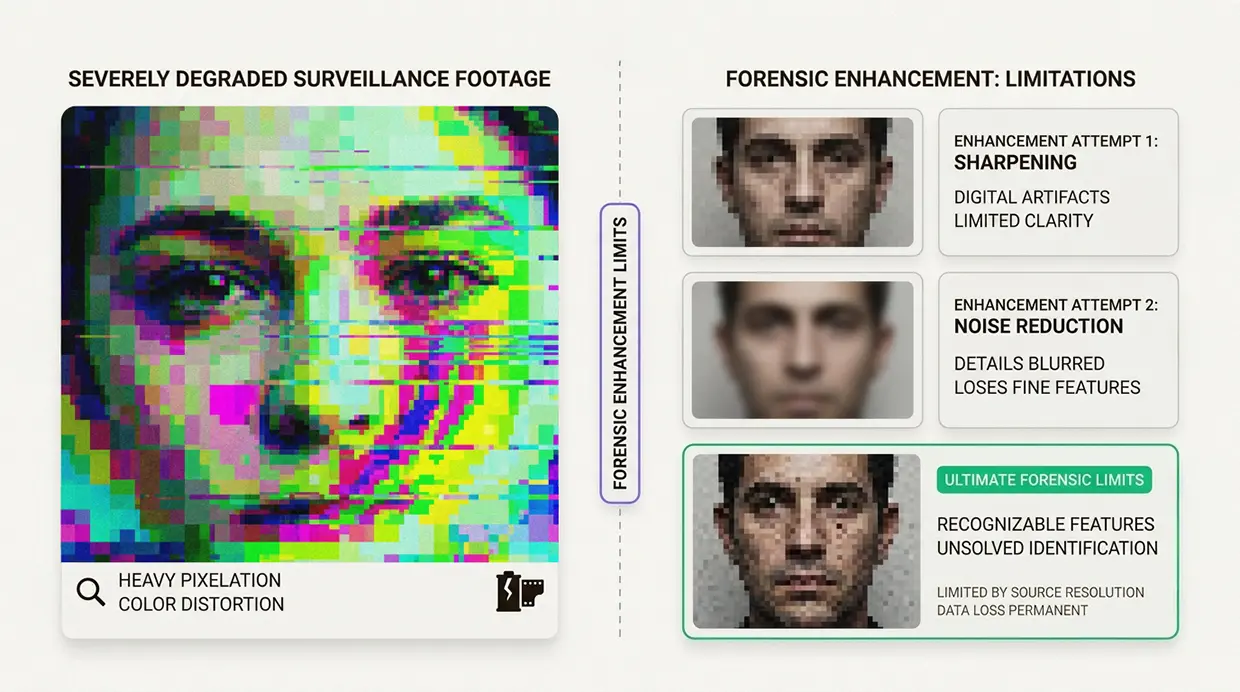
The scenario every investigator faces
You have seen it in movies and television shows. A detective squints at a blurry monitor, barks "Enhance," and suddenly a pixelated mess transforms into a crystal-clear license plate. The suspect is identified. Case closed.
Real-world forensic video analysis does not work this way. The technology to magically create detail from nothing does not exist. What does exist is a set of scientific techniques that can sometimes improve the visibility of information that is already present in the video file. Sometimes.
Understanding the difference between what enhancement can and cannot do is critical for investigators, attorneys, and law enforcement professionals who depend on video evidence. Unrealistic expectations lead to wasted resources, disappointed clients, and in the worst cases, compromised investigations.
The core question: Can you actually enhance a license plate?
The honest answer comes in three parts:
- Sometimes if the data exists in the original recording
- Often with limited improvement only
- Many times not possible at all
Here is the fundamental principle that every investigator needs to understand: If the camera never captured the detail, it cannot be recovered later.
This distinction separates clarification from reconstruction. Clarification improves the visibility of existing pixel data. Reconstruction creates data that was never there. One is forensic science. The other is speculation.
In forensic video analysis, enhancement means clarification. It means using techniques like contrast adjustment, brightness balancing, sharpening within strict limits, noise reduction, and frame averaging to make existing information more visible. It does not mean inventing characters that the camera failed to record.
How license plates are captured (and why most fail)
Most license plate enhancement failures happen at the moment of capture, not during analysis. Understanding why requires examining how surveillance cameras actually work.
Resolution limitations
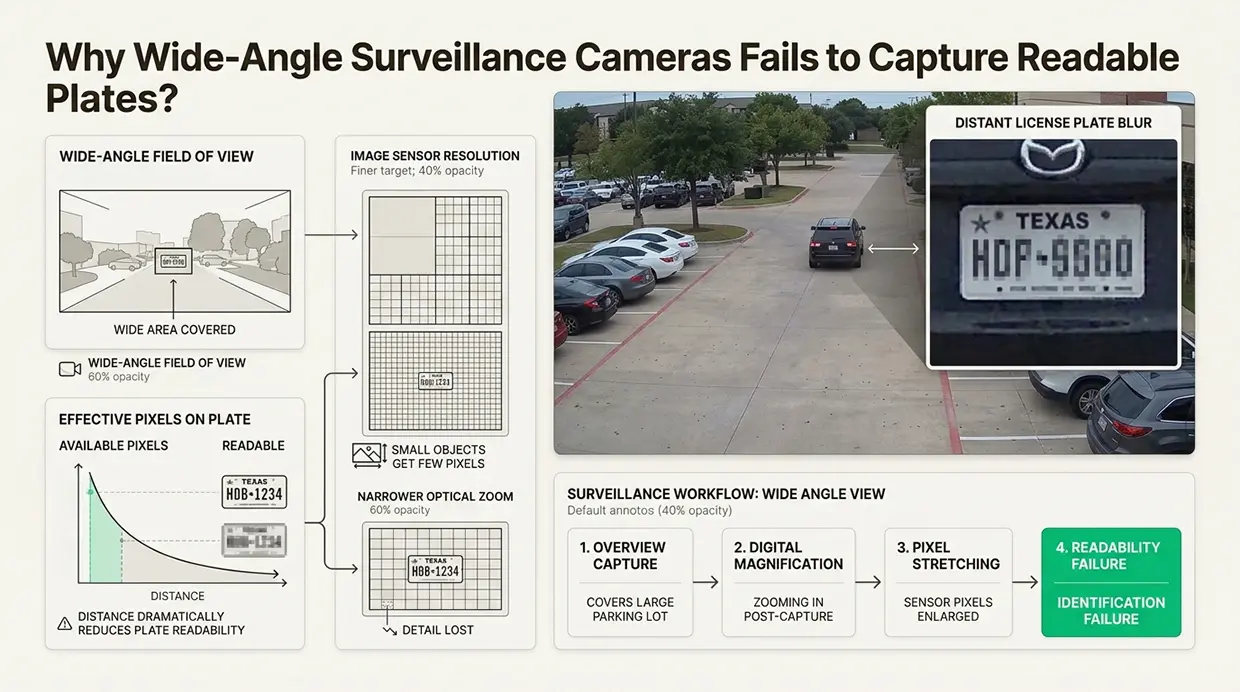
A license plate must occupy enough pixels in the frame to be readable. According to industry standards and forensic guidelines, most license plate recognition systems require at least 150 pixels across the full plate width for reliable automated reading. For forensic examination, you need at least 10 pixels of height per character, with 30 or more pixels being optimal.
Most security cameras, even HD cameras at 1920x1080 resolution, are positioned to monitor wide areas. A license plate on a vehicle passing on a road outside a building might occupy only 20 to 50 pixels total. At that resolution, individual characters become indistinguishable blocks of color.
Motion blur
Vehicle speed versus camera shutter speed creates motion blur. If a car moves quickly while the camera uses a slow shutter speed (common in low-light conditions), the plate smears across multiple pixels. The information is literally spread out and mixed with adjacent pixels. No amount of enhancement can unmix what physics has blended.
Compression artifacts
CCTV systems heavily compress video to save storage space. Compression algorithms discard information the encoder deems less important. Fine details like license plate characters are often the first casualties. Once compressed away, that information is gone forever.
Lighting issues
License plates use reflective materials designed to bounce light back to sources like headlights. This creates problems for surveillance:
- Headlight glare can wash out plates entirely
- IR reflection from infrared illuminators can blind the camera
- Low light forces cameras to use slower shutter speeds, increasing motion blur
Distance and angle
The farther the camera from the plate, the fewer pixels the plate occupies. Combined with angle (most cameras look down at vehicles rather than straight on), perspective distortion further reduces readability.
Most failures happen at capture, not analysis. A forensic analyst cannot recover detail that the camera never recorded.
What forensic enhancement can and cannot do
What enhancement can do
Forensic video enhancement uses scientifically validated techniques to improve visibility of existing information:
- Contrast adjustment Improves differentiation between characters and background
- Brightness balancing Corrects overexposure or underexposure issues
- Sharpening Emphasizes edges within strict limits (excessive sharpening creates artifacts)
- Noise reduction Removes compression artifacts and sensor noise
- Frame averaging Combines multiple frames to improve signal-to-noise ratio
- Temporal analysis Uses information from adjacent frames where characters may be clearer
- Deinterlacing Corrects artifacts from interlaced video formats
- Perspective correction Rectifies angled plates to frontal view
Temporal analysis: the most powerful tool
When video contains multiple frames of the same vehicle, temporal analysis becomes invaluable. Characters that are blurred or obscured in one frame may be clearer in another. By combining information across frames, analysts can improve the signal-to-noise ratio without introducing new artifacts.
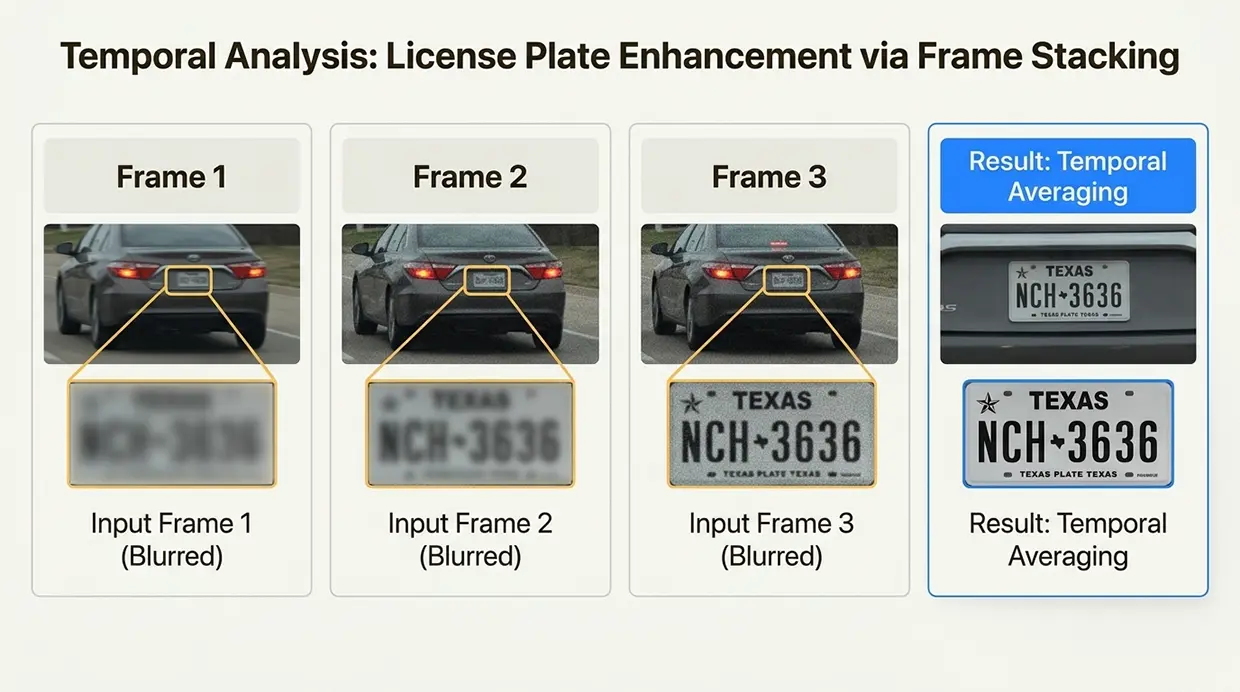
The technique works because license plates are rigid objects moving through the scene. While the plate moves, individual characters maintain their relative positions. Sophisticated software can align frames and combine them to extract consistent detail.
However, temporal analysis is still constrained by what was captured. It amplifies existing signal. It does not create new information.
Pixel resolution requirements
The hard limit of enhancement is pixel resolution. Here is the breakdown:
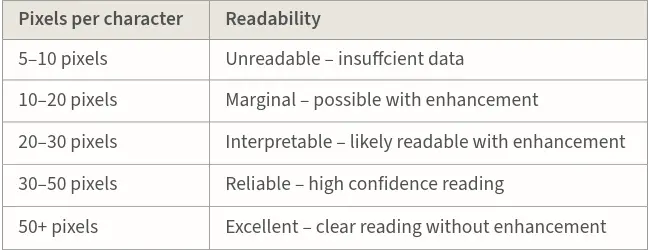
You cannot extract detail that does not exist at the pixel level. Digital zoom (magnifying a small region of the image) does not create new resolution. It simply makes existing pixels larger.
What enhancement cannot do
Forensic enhancement cannot:
- Create missing characters that the camera failed to capture
- Reconstruct plates from insufficient resolution
- "Guess" numbers or letters based on probability
- Remove motion blur entirely (information is lost, not just obscured)
- Recover from severe overexposure (blown highlights contain no recoverable data)
If a system claims to "fill in" missing characters using AI or machine learning, it is no longer performing forensic analysis. It is speculating.
AI, standards, and court defensibility
What AI gets wrong about license plates
Artificial intelligence has created powerful tools for license plate recognition. However, these tools come with significant limitations that investigators must understand.
Amped DeepPlate provides a useful example. This AI-powered tool reads severely degraded license plates for investigative purposes. But Amped Software explicitly states that DeepPlate is not for evidentiary use. The tool provides a "proposed reading," not a definitive identification.
The problem with AI-based enhancement is explainability. When an AI system "fills in" a missing character, it bases that decision on patterns learned from training data. The system cannot explain why it chose a specific character. It cannot show its work. In a courtroom, this lack of explainability makes AI-generated results inadmissible as evidence.
Confidence scores compound the problem. An AI might report 99% confidence that a character is "B" when it is actually "D." The neural network is confident, but wrong. As Amped notes in their documentation: "The neural network is far less prudent than a human in reporting confidence levels."
If a system is guessing a character, it is no longer analysis. It is speculation.
Forensic standards and requirements
Forensic video enhancement must meet rigorous standards to be admissible in court. The Scientific Working Group on Digital Evidence (SWGDE) and NIST OSAC have established guidelines that all forensic video analysis must follow:
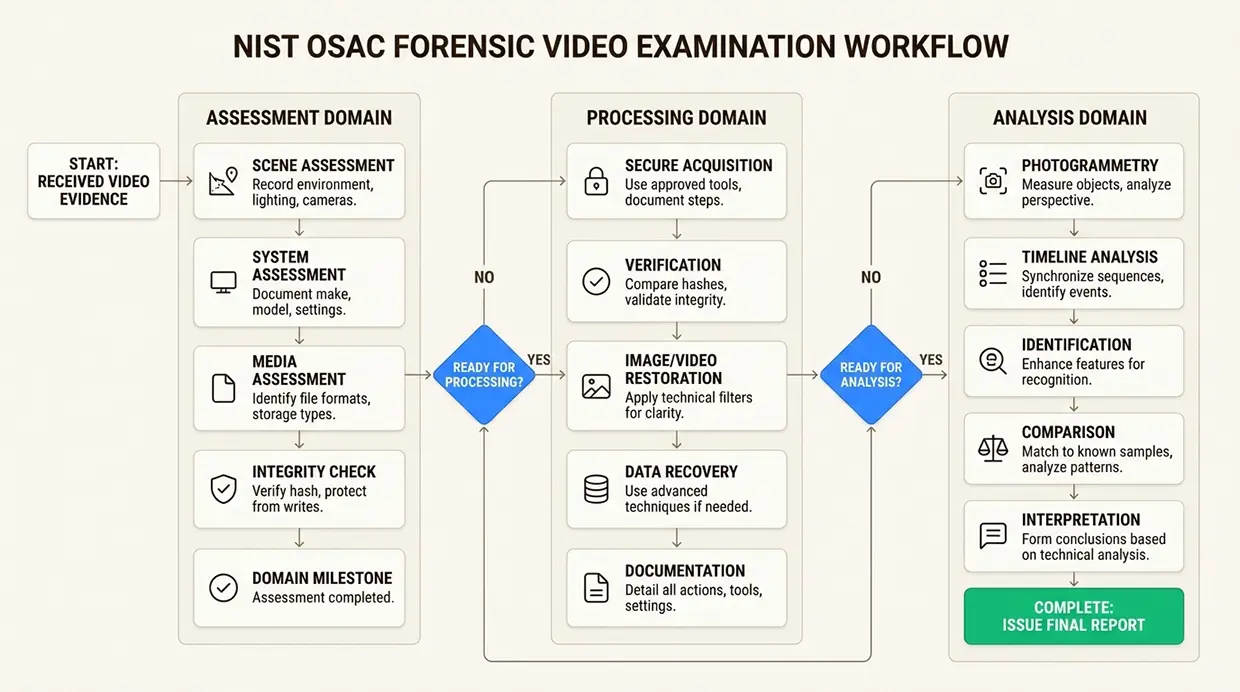
Every enhancement step must be:
- Documented Complete record of all processing applied
- Repeatable Another qualified examiner can reproduce the results
- Non-destructive Original evidence is preserved unaltered
Additional requirements include:
- Hash verification Cryptographic confirmation that original files remain unchanged
- Chain of custody Documented handling from collection to courtroom
- Working copies All processing performed on copies, never originals
- Native format preservation Original codec and container maintained when possible
What a forensic conclusion actually looks like
Forensic video analysts use careful, probabilistic language in their conclusions:
- "Consistent with" The plate appears consistent with a specific registration
- "Identified as" Rarely used, requires exceptional clarity
- "Cannot exclude" The plate could match, but certainty is limited
- "Inconclusive" Insufficient information for any determination
Confidence levels must be interpreted carefully. A high confidence score from software does not mean the character is certainly correct. It means the software is certain, which is not the same thing.
Realistic outcomes
License plate enhancement produces four categories of results:
- Clear Identification Rare, but possible with high-quality source video
- Partial Plate Recognition Common; some characters readable, others ambiguous
- Exclusion of Possibilities The plate definitely does not match certain candidates
- No Usable Result Also common and important; knowing what you cannot determine is valuable
Understanding these outcomes helps investigators allocate resources effectively. When enhancement produces no usable result, pursuing other investigative leads becomes the priority.
Video forensics can clarify what was captured but cannot recreate what was never there
What law enforcement and attorneys should do
When video evidence contains a potentially readable license plate, proper handling from the start maximizes the chance of successful enhancement:
- Preserve original footage immediately Do not wait; systems overwrite old footage automatically
- Obtain native export Get the original file format from the DVR/NVR, not a screen recording
- Document camera system details Resolution, frame rate, codec, and camera specifications help analysts understand what was captured
- Avoid re-encoding Every conversion loses information; maintain original format when possible
- Engage forensic expert early Expert guidance prevents mistakes that compromise evidence
- Build case on multiple evidence types Do not depend solely on license plate enhancement
When to contact a forensic expert
If your investigation depends on reading a license plate from video, contact a qualified forensic video analyst as early as possible. At Black Dog Forensics, we provide court-defensible video analysis following SWGDE and NIST standards.
Our team can:
- Assess whether enhancement is likely to succeed before you invest resources
- Apply scientifically validated enhancement techniques
- Document every step for courtroom admissibility
- Provide expert testimony on video evidence
- Guide your evidence preservation strategy
Our methods stand up to rigorous legal scrutiny because we follow established forensic standards and tell you honestly what the evidence can and cannot support.
The bottom line
License plate enhancement is not magic. It is constrained by physics, mathematics, and the fundamental reality that cameras cannot capture what they cannot see. Video forensics can clarify what was captured. It cannot recreate what was never there.
Understanding these limitations protects your investigation from wasted effort and your case from challenges in court. When you need forensic video analysis you can trust, contact Black Dog Forensics. We retrieve the truth from digital evidence, following the digital trail with focus and integrity.


