


 346-200-6097
Why Context Matters More Than Isolated Messages

You have been here before. Discovery arrives, and with it comes a thumb drive containing thousands of text messages, call logs, browser history entries, and location data points. The prosecution has distilled this mountain of data into a handful of "smoking gun" messages that seem to prove your client's guilt beyond doubt. The sheer volume feels overwhelming. The narrative feels predetermined.
But here is what you need to remember: that phone dump is not the whole story. It is often just the starting point, and frequently, it is a story told without context.
At Black Dog Forensics, we help criminal defense teams turn raw digital data into courtroom-ready narratives. We have seen how a defense-oriented digital forensic review can transform cases, particularly when the goal is proving state of mind, establishing coercion, or contextualizing behavior that looks criminal on the surface but tells a different story upon deeper examination.
This article explains how defense teams can go beyond the basic phone dump to uncover digital evidence that speaks directly to state of mind and challenges prosecution narratives.
The Limits of the Basic Phone Dump
A typical phone dump is exactly what it sounds like: a bulk export of data extracted from a mobile device. Law enforcement forensic examiners use various tools (most commonly Cellebrite) to pull text messages, call logs, browser history, photos, videos, and application data from seized devices. This extraction becomes the foundation of the prosecution's digital evidence case.
The problem is not that this data is wrong. The problem is that it is incomplete, often misleading when presented without context, and shaped by the extraction method in ways that matter for your defense.
Extraction Method Matters
Modern smartphones store data on solid-state drives using flash memory chips, not traditional spinning hard drives. This creates unique forensic challenges that can affect what evidence gets captured:
- Logical Extraction : A logical extraction collects only the data that is accessible through the device’s operating system and standard APIs. This typically includes active user data such as contacts, call logs, messages, and some application data. Because it relies on the OS to provide access, it does not capture deleted data, unallocated (“slack”) space, or deeper artifacts stored within application databases or system areas.
- Advanced Logical Extraction : An advanced logical extraction goes a step further by leveraging enhanced access methods, backups, or application-level parsing to retrieve more comprehensive datasets than a standard logical extraction. This may include additional app data, system files, and structured databases that are not exposed through basic APIs. However, like logical extractions, it still generally does not include true unallocated space or fully recover deleted artifacts at the file system level.
- Full File System (FFS) Extraction : A full file system extraction is today’s flagship ideal collection. It captures the entire file system structure of the device, including system directories, application data, and hidden files. This method provides significantly more visibility into user activity, including artifacts such as application databases, logs, and sometimes remnants of deleted data. While not always a true “bit-for-bit” physical image, an FFS offers a forensically rich dataset that allows examiners to analyze deeper system and user activity than logical methods alone.
- Physical Extraction (On-Device / Debug-Based): Physical extraction occurs a few and far between, but attempts to obtain a bit-for-bit image of the device’s storage using the device’s own hardware interfaces (e.g., bootloader exploits or debugging modes). This can include both allocated and unallocated space, allowing for potential recovery of deleted data. However, this method typically requires the device to be powered on and in a specific state, which introduces risk; background processes such as system writes or garbage collection may continue to modify data during acquisition.
- Direct Acquisition (JTAG / Chip-Off) : Direct acquisition methods, such as JTAG or chip-off, involve accessing the device’s memory outside of the operating system entirely. JTAG interfaces with test access ports on the circuit board, while chip-off physically removes the memory chip for direct reading. These methods can recover data from damaged, locked, or inoperable devices and may provide access to raw memory contents, including deleted data. However, they require specialized equipment and expertise, are time-intensive and costly, and, in the case of chip-off, are destructive to the original device. Typically, in today’s environment, the dataset that would be collected is encrypted, so it is likely useless. However, with the right phone, the right OS, the data might still be accessible.
The extraction method used by law enforcement determines what evidence was even available to the prosecution. If they used logical extraction on a phone with significant deleted data, they may have missed exculpatory evidence entirely.
The Cherry-Picking Problem
Perhaps the most significant limitation of the basic phone dump is selective presentation. Prosecutors frequently isolate individual messages or data points that appear incriminating while ignoring the broader context. A threatening text from your client looks very different when surrounded by messages showing fear, duress, or coercion. A location ping seems damning until you see the pattern of constant tracking that preceded it. In some instances, the DA’s office attempted to show location, but when taken holistically, it was shown that the person was present unwillingly.
The phone dump provides fragments. Your job is to reconstruct the full picture.
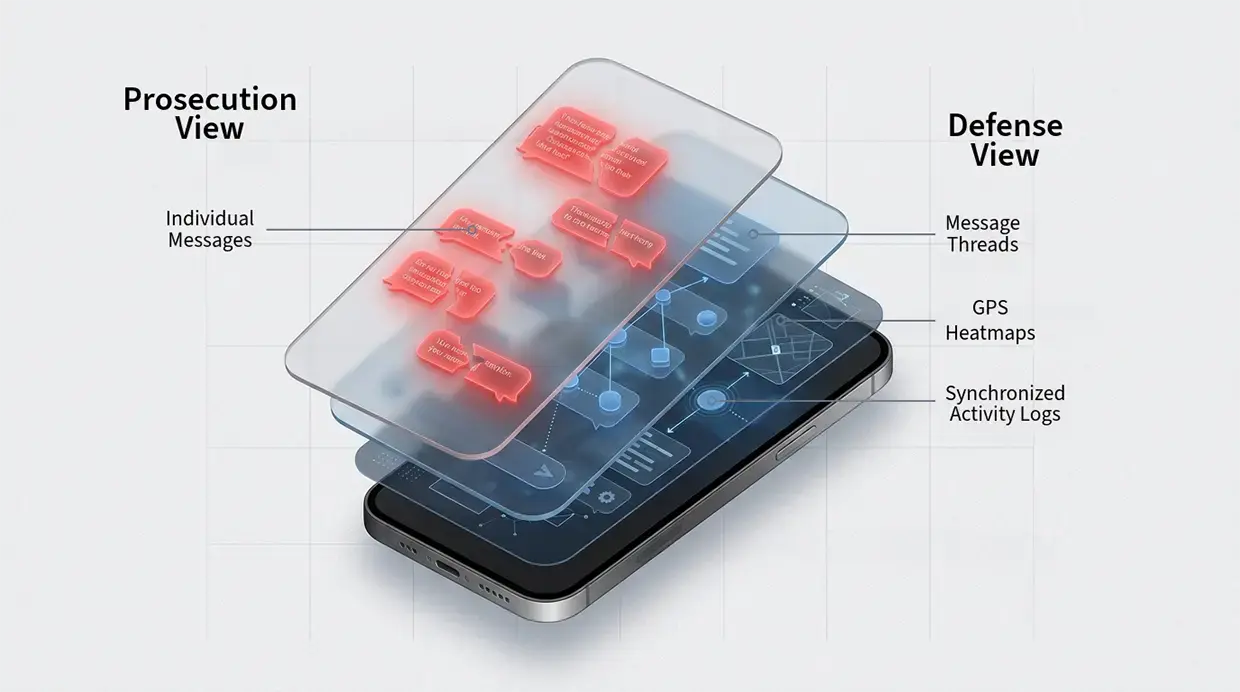
Digital Evidence That Shows State of Mind
Digital forensics for criminal defense is not just about finding different messages. It is about analyzing patterns across multiple data sources to reveal what was actually happening in your client's life and mind during the relevant time period.
Messaging Threads: Patterns Over Time
Isolated messages can mislead. Message threads over weeks or months can reveal:
- Shifts in communication patterns: A victim of trafficking who initially resisted but gradually complied may show increasingly rapid response times to their controller, reflecting learned helplessness and conditioning.
- Tone and language analysis: Messages that initially expressed independence or resistance, followed by increasingly submissive language, can demonstrate coercion over time.
- Frequency and timing: Bursts of messages before alleged criminal acts, or constant check-ins throughout the day, can show surveillance and control rather than voluntary association.
Search History and App Usage
What someone searches for and which apps they use can illuminate their mental state:
- Search queries about safety, escape, or legal rights: may counter narratives of willing participation
- Mental health-related searches: can establish context for behavior
- App usage patterns: Constant checking of messaging apps (anxiety, fear of punishment), or use of safety/tracking apps (awareness of being monitored)
Location History and Movement Patterns
GPS data tells more than where someone was. It can show:
- Unusual movement patterns: Being transported between locations without independent stops
- Rapid location changes: Inconsistent with normal activity, suggesting control or lack of autonomy
- Correlation with threatening messages: Location compliance following threats
Wearables and IoT Devices
Smartwatches, fitness trackers, and other connected devices create additional evidence streams:
- Heart rate data: showing elevated stress levels during key periods, and in some cases instant heart stopping
- Sleep disruption: which can be consistent with trauma or fear
- Activity patterns: that contradict claims of voluntary, planned criminal behavior
Fitbit Evidence has already been admitted in criminal trials, most notably we have used it in several murder cases where the data established the victim's activity levels and timing of death. These devices can equally support defense narratives about a defendant's physical, mental state, or timing of death.
Notes and Third-Party Data
Do not overlook:
- Notes apps: containing survival strategies, fear documentation, or evidence of planning to escape
- Ride-share logs: showing transportation arranged by others
- Payment app transactions: documenting economic control or quotas
- Social media direct messages: revealing isolation from support networks
The key insight: digital evidence in human trafficking cases and other coercion scenarios rarely lies in a single "smoking gun." It lives in patterns across multiple data sources over time.
Real-World Example: Digital Evidence in a Trafficking Case
To understand how proving state of mind with digital evidence works in practice, consider a composite case based on patterns we have seen in actual trafficking prosecutions.
The Prosecution's Narrative
Maria (not her real name) was charged with prostitution-related offenses after an undercover sting operation. The prosecution's evidence included:
- Text messages arranging appointments
- Online advertisements for services
- Payment app transactions sending money
- Location data showing her presence at a hotel
On the surface, this looked like voluntary criminal activity. The phone dump provided plenty of incriminating fragments.
The Defense's Deeper Digital Forensic Review
Our team at Black Dog Forensics conducted a comprehensive analysis that revealed a very different picture.
The Controller's Digital Footprint
Buried in the message threads were years of communications with a man named Marcus (name changed) - Although that is the name of the first pimp our Founder arrested (a story for another day). The pattern was unmistakable when viewed chronologically:
- Threats and punishment: Messages like "You know what happens when you don't answer" and "Last time you tried to leave, remember?" established a documented history of coercion.
- Constant surveillance: Location-sharing demands appeared dozens of times daily. Marcus required Maria to share her location before, during, and after appointments. Non-compliance triggered punishment.
- Economic control: Payment app records showed money flowing to Marcus, not Maria. He controlled every transaction. When she occasionally received cash directly, subsequent messages showed him demanding it be transferred immediately.
- Social isolation: Analysis of social media direct messages showed Maria had attempted to reach out to friends and family early in the relationship, but Marcus's control tightened over time. Her communication with the outside world dropped to nearly zero.
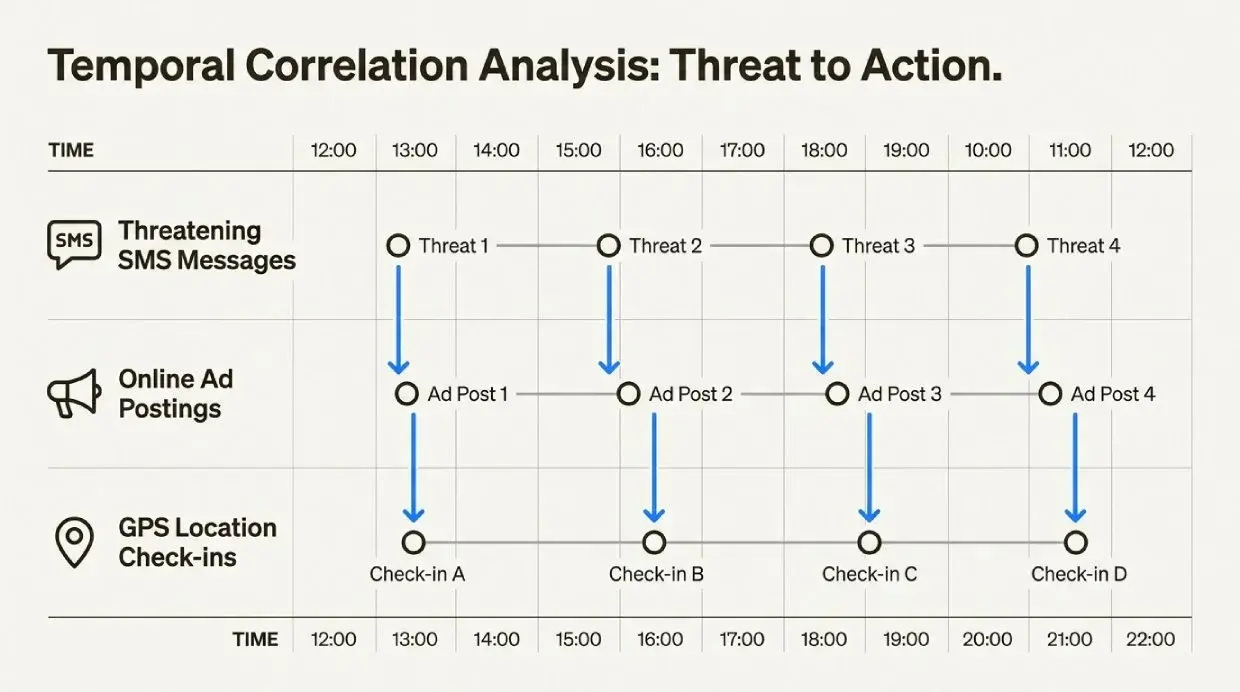
Timeline Correlation
The "criminal" acts occurred in a specific pattern:
- Marcus sent threatening or demanding messages
- Within minutes to hours, Maria arranged appointments (which Marcus had posted online - DA’s office failed to mention)
- Following completion, she immediately reported back to Marcus
- If response times were slow, punishment threats followed (Bitch, Whore, Answer me)
This pattern repeated consistently over months. The digital evidence showed not a voluntary criminal enterprise, but survival behavior under conditions of documented coercion.
Wearable Device Data
Maria's Apple Watch showed:
- Severely disrupted sleep patterns (consistent with trauma) and “in-calls”
- Elevated resting heart rates during the weeks in question, as compared to the medically captured resting heart rate later on
- Minimal physical activity outside of scheduled appointments (consistent with being held in the hotel and limited freedom)
Supporting Expert Testimony
The structured chronologies, message patterns, and app-usage trends we generated provided the foundation for a trauma specialist's expert opinion. The medical expert could rely on concrete digital evidence to explain:
- How Maria's "choices" in key moments were consistent with a conditioned fear response
- The documented pattern of coercive control that eliminated genuine choice
- Why Maria's behavior appeared voluntary to law enforcement, while actually representing survival under duress
The Outcome
Presented with the complete digital narrative, prosecutors reduced charges significantly. The jury was going to hear not just fragments of text messages, but the full story of coercion and control that those fragments represented. Digital forensics transformed the case from a simple prosecution into a complex examination of victimization and survival.
A Defense Strategy Framework for Using Digital Evidence
How can you apply this approach to your own cases? Here is a practical framework we use at Black Dog Forensics.
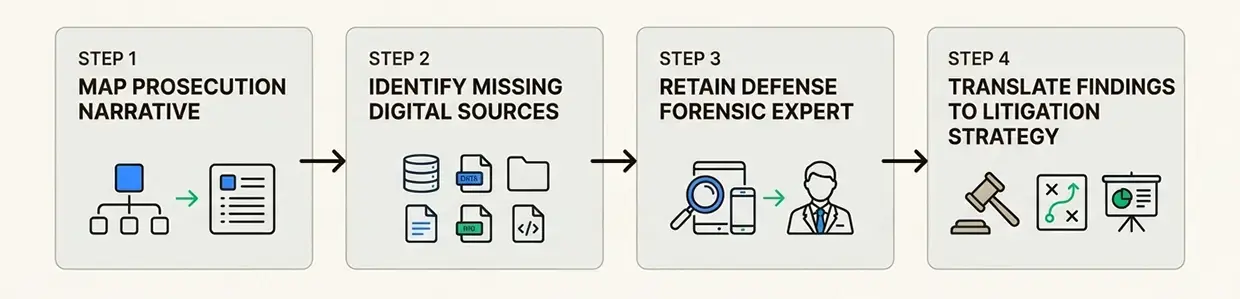
Step 1: Map the Prosecution's Narrative
Before diving into the data, understand exactly what story the prosecution is telling:
- Which specific digital evidence are they relying on?
- What is their theory of criminal intent or knowledge?
- What gaps or assumptions exist in their narrative?
- Which time periods are they focusing on, and which are they ignoring?
This mapping helps you identify what additional evidence might change the story.
Step 2: Identify Missing Sources
The phone dump is rarely the complete digital picture. Consider:
- Unexplored devices: Tablets, laptops, secondary phones, smartwatches
- Missing accounts: Social media, email, cloud storage the defendant actually used
- Third-party records: Ride-share apps, payment platforms, hotel booking sites
- IoT devices: Smart home devices, fitness trackers, vehicle systems
- Time gaps: Periods not covered by the extraction, or deleted data that may be recoverable
Step 3: Retain a Defense-Focused Forensic Expert
This is where we come in. Black Dog Forensics provides:
- Exculpatory data review: We look for evidence that supports your defense theory, not just evidence that confirms guilt
- Timeline generation: Detailed chronologies that show patterns over time, not isolated incidents
- Pattern analysis: Correlation between different data sources (messages + locations + payments + app usage)
- Expert testimony preparation: Findings structured to support medical and mental health expert opinions
Our approach treats digital forensics as a strategic tool for proving state of mind, not just a technical exercise in data extraction.
Step 4: Translate Findings into Litigation Strategy
Digital evidence findings become actionable through:
- Motions to suppress or limit: Challenging unreliable extraction methods or authentication issues
- Motions to contextualize or limit prosecution’s testimony: Seeking admission of broader patterns that explain seemingly incriminating fragments or limiting the State/Gov’s statements to items taken out of context
- Cross-examination themes: Using technical limitations to challenge prosecution expert testimony
- Defense narrative development: Building a coherent story that addresses the state of mind and intent
The goal is not just to challenge individual pieces of evidence, but to transform how the jury understands the entire digital record.
Practical Questions to Ask Your Digital Forensics Expert
When you engage a defense digital forensics expert, focus your questions on the state of mind and context:
Scope and Sources
- What digital sources did the government's extraction not examine?
- What extraction method was used, and what evidence might it have missed?
- Are there deleted data or time gaps we should attempt to recover?
Data Integrity
- Does the extraction method risk losing or misrepresenting data?
- Are hash values available to verify evidence integrity?
- Can we independently verify the prosecution's forensic copies?
Pattern Analysis
- Are there patterns in messaging, locations, or app usage that support a fear-based or coerced response?
- What do usage timelines reveal about mental state during key periods?
- Can we identify surveillance or control patterns in the data?
Alternative Explanations
- What digital traces support alternative timelines or benign explanations?
- Can we reconstruct what was actually happening versus what the prosecution claims?
- Are there exculpatory patterns hidden in the full data set?
Expert Integration
- How can these findings be explained in plain language to a jury?
- How do they integrate with a medical expert's opinion about trauma or coercion?
- What visual aids (timelines, charts, maps) would best communicate the digital evidence story?
Technical Challenges
- Can we challenge the prosecution's extraction methodology?
- Are there authentication or foundation issues with their evidence?
- What cross-examination opportunities exist for their forensic examiner?
Moving Beyond the Dump to Uncover the Truth
Digital evidence is not just about "what happened." In the right hands, it can illuminate the "why" and "how" behind a defendant's behavior. This is especially true in cases involving trauma, coercion, and conditioning, where surface-level digital fragments can tell a misleading story.
The basic phone dump serves prosecutorial convenience. It isolates incriminating fragments and presents them without context. But defense teams have options beyond accepting that narrative.
A defense-oriented digital forensic review can:
- Reconstruct the full context surrounding allegedly criminal acts
- Reveal patterns of coercion, control, and fear that explain behavior
- Support expert testimony about trauma responses and mental state
- Challenge unreliable extraction methods and selective presentation
- Transform seemingly damning evidence into proof of victimization
At Black Dog Forensics, we believe every defendant's digital story deserves to be fully told. Not just the fragments that support a conviction, but the complete record that reveals context, state of mind, and truth.
If you are handling a case where digital evidence plays a central role, particularly one involving potential coercion, trafficking, or complex mental health issues, we encourage you to rethink the basic phone dump. Digital forensics can be a strategic tool for proving state of mind and contextualizing behavior. The data is there. The question is whether you are seeing the full picture or just the prosecution's selected fragments.
We invite you to contact Black Dog Forensics for help reviewing digital evidence and collaborating with medical experts in active or upcoming cases. Whether you need a comprehensive forensic analysis, assistance in challenging prosecution evidence, or expert testimony for trial, we are here to help defense teams uncover the complete digital story.

